That last one sticks around for a reason, but most buyers can't explain why — or how a Gaylord box differs from the pallet it sits on. That confusion causes real problems: ordering the wrong wall thickness, mismatching a box to an undersized pallet, or paying for capacity you don't need.
This guide breaks down what a Gaylord box actually is, where the name came from, the main types and materials available, and how to size one correctly. We'll also cover why the pallet underneath matters just as much as the box itself.
Key Takeaways
- Gaylord boxes are large corrugated, plastic, or metal bulk containers designed to sit on a pallet
- The name comes from Gaylord Container Corporation and is now used generically industry-wide
- Pallets provide structure; Gaylord boxes provide containment—they are separate components
- Load capacity ranges from roughly 100 lbs to 3,000 lbs, depending on wall construction
What Is a Gaylord Box?
A Gaylord box is an industrial-sized bulk container, typically built from corrugated cardboard, corrugated plastic, or metal, sized to match a standard pallet footprint.
Smurfit Westrock groups Gaylord boxes, Octabins, and high-performance totes together as pallet-size fiber bulk bins used across industrial and food supply chains.
Construction usually follows a base-sleeve-lid pattern:
- A rigid corrugated body forms the sleeve, or "wall"
- A separate base (or attached bottom) rests on the pallet deck
- An optional lid or flap-top closes the load for transit
Most Gaylords collapse flat when empty, which saves serious warehouse space compared to rigid plastic totes. That's one reason they've stuck around for decades in facilities that need bulk containment without a permanent footprint.
Where Does the Name "Gaylord" Come From?
The name isn't marketing fluff. It comes from the Gaylord Container Corporation, one of the earliest manufacturers to mass-produce this style of large corrugated box.
Trademark records show the mark "GAYLORD BOXES" was first used commercially in December 1939 and filed for federal registration in 1962. It was officially registered in 1964.
Like Kleenex became shorthand for facial tissue, "Gaylord" became shorthand for any large corrugated bulk box, regardless of manufacturer. The registration eventually lapsed in 1984, and the term has functioned as generic industry language ever since.
Outside the US, "pallet box" is the more common term. Other names you'll encounter:
- Bulk bin
- Skid box
- Tote bin
- Octabin
Common Shapes: Rectangular vs. Octagonal
Two shapes dominate the market, and the choice affects both handling speed and structural performance.
Rectangular Gaylords are the default choice for most operations. They're easier to fill, empty, and store. They also use floor space efficiently, nesting against other rectangular loads without gaps.
Octagonal Gaylords, often called Octabins, trade some of that simplicity for strength. The eight-corner design distributes compression forces more evenly, which matters for granular or powder products that push outward on the walls.
High-performance tote (HPT) designs push this further, adding reinforced spiral-wound corner posts for extra durability under heavy stacking.
Types and Materials of Gaylord Boxes
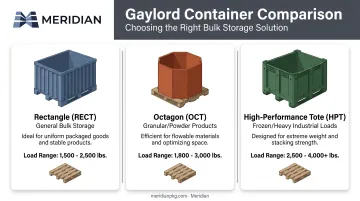
Manufacturers generally sort Gaylords into three families:
- Rectangle (RECT): General bulk storage and fulfillment
- Octagon (OCT): Loose-fill or granular products that need bulge resistance
- High-Performance Tote (HPT): Frozen food, processed food, and heavier industrial loads that need consistent stacking strength
Wall Construction Drives Capacity
Wall count is the biggest factor in how much weight a Gaylord can safely hold:
| Wall Type | Typical Load Range | Best For |
|---|---|---|
| Single-wall | Lightest loads | Low-density, low-weight goods |
| Double-wall | Around 100 lbs (standard 48x40 SKUs) | Moderate bulk loads |
| Triple-wall | Roughly 1,200-1,500 lbs | Dense or heavy bulk goods |
| Custom laminated | Up to 3,000 lbs | Specialized industrial applications |
These are product-specific benchmarks, not universal ratings. Actual capacity always depends on dimensions, board grade, and the base structure underneath.
Beyond Standard Cardboard
Material choice matters as much as wall count:
- Moisture-resistant treated corrugate — coated for food-grade or humid environments while staying recyclable
- Corrugated plastic — reusable and weatherproof; some sleeve pack designs are rated for up to 70 uses
- Metal or wire cage containers — used for heavy industrial loads, with some folding wire designs rated to 4,000 lbs
Closure style also affects loading speed and ergonomic safety:
- Open-top: Fast bulk drops, but contents stay exposed to weather
- Flap-top and fitted-lid: Better product protection with slower loading
- Sleeve-pack: Access doors for manual picking, which cuts bending and reaching on the floor
More operations are shifting toward reusable, returnable Gaylord formats and recycled-content boxes as sustainability pressure grows across supply chains.
Gaylord Box vs. Pallet: What's the Difference?
This is where most sourcing mistakes happen. A pallet and a Gaylord work together as one unit load, but they are not the same product and are not interchangeable on a spec sheet.
In plain terms:
- A pallet is the flat structural platform (wood, plastic, or metal) built for forklift and pallet-jack transport
- A Gaylord box is the bulk container that sits on that pallet and holds loose or bulk goods
Why the distinction matters: A Gaylord's stability in transit depends entirely on the pallet beneath it. Load a heavy triple-wall Gaylord onto a warped, undersized, or inconsistent pallet, and you've created a tipping hazard before the forklift even moves.
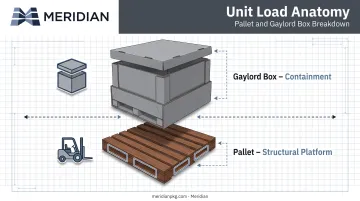
The box can be well built and still fail if its base isn't.
So why do people use "pallet box" and "Gaylord" interchangeably? Partly regional habit. Some manufacturers also sell integrated units with a corrugated pallet base built in, so you don't need a separate wood pallet.
Technically, they remain two components of one unit load: the pallet handles structure, the Gaylord handles containment.
How Much Does a Gaylord Box Hold? Capacity and Common Uses
Capacity comes down to three variables: footprint (usually matched to a standard 48" x 40" pallet), height, and wall thickness. Typical weight ratings by construction:
- Double-wall: up to around 100 lbs
- Triple-wall: roughly 1,200–1,500 lbs
- Custom laminated bins: up to 3,000 lbs
A common field configuration is a 40" x 40" x 40" triple-wall container rated around 1,100 lbs. It is stackable and built for standard forklift and pallet handling—what mid-range industrial buyers typically spec.
Matching box to product is the real skill. Bulky, lightweight goods like textiles or apparel need larger volume more than high weight ratings. Dense goods like scrap metal or produce need higher weight-rated construction, even in a smaller footprint.
Where Gaylords Show Up Most
- Food and agriculture — bulk ingredients, produce, grains, dry goods
- Retail and thrift — bargain bins and discount merchandising
- Manufacturing — loose parts, resins, scrap materials
- Recycling and waste streams — sorting and collection before processing
Choosing the Right Gaylord Box (and Why the Pallet Underneath Matters)
Picking the right Gaylord starts with a few straightforward questions:
- What's the product weight and density? Heavier, denser goods push you toward triple-wall or laminated construction.
- What load capacity do you actually need? Don't over-spec for margin alone. It adds unnecessary cost.
- Single-use or reusable? Closed-loop operations with predictable returns often save money with corrugated plastic despite higher upfront cost.
- Does your industry require specific hygiene or handling standards? Food-grade applications need moisture-treated or laminated options.
Here's the part buyers often overlook: even a perfectly specified Gaylord box is only as reliable as the pallet underneath it. If pallet quality varies from one facility to the next, you're not just risking a single damaged shipment. You're introducing inconsistent stability across your entire bulk-container program, which raises damage claims and slows throughput at receiving docks.
For heavier triple-wall loads, Grade A pallets rated up to 4,600 lbs are the safer match. Look for reinforced corners and four-way forklift entry.
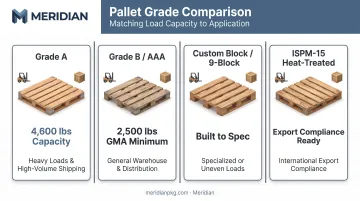
Pallet options that commonly pair with Gaylords include:
- Grade A: Up to 4,600 lbs for heavy triple-wall loads
- Grade B or AAA: Around the 2,500-lb GMA minimum for lighter duty
- Custom block / 9-block: Specialized or uneven load requirements
- ISPM-15 heat-treated: Export compliance on international bulk shipments
This is where a lot of mid-to-large enterprises hit friction. Managing pallet specs consistently across multiple facilities is harder than it sounds.
Meridian Packaging's network of 2,400+ trusted partners across the US helps companies running high-volume Gaylord or bulk-container programs secure correctly specified pallets every time. That beats sourcing ad hoc at each facility and hoping the specs line up.
Frequently Asked Questions
Why do they call it a Gaylord box?
The name comes from the Gaylord Container Corporation, which manufactured and popularized large corrugated bulk boxes starting in the late 1930s. Like Kleenex or Xerox, the brand name became generic industry shorthand.
What is the difference between a Gaylord box and a pallet?
A pallet is the load-bearing platform built for forklift and pallet-jack transport. A Gaylord box is the bulk container that sits on top of it to hold loose or bulk goods. They are two separate components of one unit load.
How much does a Gaylord box hold?
Capacity depends on wall construction and size. Double-wall boxes typically hold around 100 lbs, triple-wall units handle roughly 1,200-1,500 lbs, and custom laminated bins can reach up to 3,000 lbs.
Are Gaylord boxes reusable or recyclable?
Corrugated cardboard Gaylords are widely recyclable, with the US cardboard recycling rate at 71-76%, and are sometimes reused a few times before recycling. Corrugated plastic versions are built for extended reuse, with some designs rated for up to 70 cycles.
What size is a standard Gaylord box?
Most Gaylords are sized to match standard pallet footprints, commonly 48" x 40", with heights ranging from around 24 inches up to nearly 60 inches depending on the design and manufacturer.
How much does a Gaylord box cost?
Cost varies by material, wall thickness, board grade, reinforcement, and order volume. Single-use corrugated units usually cost less than reusable plastic designs built for dozens of cycles.