Introduction
A pallet arrives at the dock, its cartons sealed tight by a single strip of tape. No glue gun, no water, no heat gun involved. Press it down, and it grips instantly.
That's pressure-sensitive tape, commonly called PSA tape, and it shows up everywhere in packaging and industrial work—carton sealing, automotive assembly, electrical jobs—yet many teams still pick it with little scrutiny.
Many procurement teams default to whatever tape their supplier stocks, without understanding why one chemistry or backing outperforms another for their specific use case. That gap costs money in reseals, product damage, and wasted labor.
This guide breaks down what PSA tape actually is, how it's manufactured, the three adhesive chemistries that dominate industrial use, and how to choose the right product for your operation.
Key Takeaways
- PSA tape bonds instantly under light pressure: no water, heat, or solvent activation required
- Three forces control performance: adhesion, cohesion, and tack
- Acrylic, rubber, and silicone are the three dominant adhesive chemistries for matching tape to temperature, UV, and surface conditions
- Backing choice (BOPP, cloth, paper, PVC) sets tear strength and conformability
- Testing tape under real operating conditions beats guessing based on a spec sheet
What Is Pressure-Sensitive Tape?
The Pressure Sensitive Tape Council defines PSA tape by three characteristics: it's permanently tacky at room temperature, it adheres with light finger pressure, and it undergoes no liquid-to-solid phase change during application (PSTC).
That last point matters more than it sounds. Liquid adhesives, gummed tape, and heat-seal systems all require an activation step: water to wet the glue, heat to melt a film, or a curing period before the bond reaches full strength. PSA tape skips all of that. It arrives fully formulated and ready to bond the moment it touches a surface.
The Three Forces Behind the Bond
Three properties work together, and often against each other, to make PSA tape function:
- Adhesion — how strongly the tape bonds to the surface it's applied to
- Cohesion — the adhesive's internal strength, or how well it holds itself together under stress
- Tack — the immediate grip you feel the instant you press the tape down
Push one property too far and another suffers. A super-tacky adhesive with weak cohesion will grab instantly but leave residue behind when removed. A high-cohesion formula built for long-term shear strength might feel less grabby on first contact.
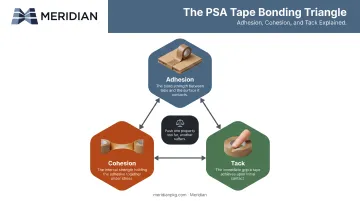
This balancing act comes down to viscoelasticity. The adhesive behaves like a liquid and a solid at the same time. Under pressure, it flows into the microscopic texture of a surface and maximizes contact area. Its elastic, solid-like structure keeps it from oozing or falling apart under load.
That same principle has been at work for a long time. According to the Journal of the American Institute for Conservation, PSA tape was first developed in 1845 by Dr. Horace Day, a surgeon who coated cloth with natural rubber adhesive to create surgical tape (JAIC, 1984). The chemistry has evolved since then, but the core principle remains the same.
How PSA Tape Is Made: Components and Formats
Every PSA tape is built from a small set of layers, though not every construction uses all of them.
Most single-coated tapes combine an adhesive layer with a backing (carrier) material. Double-coated and adhesive transfer tapes typically add a release liner to keep the adhesive from bonding to itself before use, enabling clean, controlled unwind off the roll.
Three Standard Formats
| Format | Construction | Typical Use |
|---|---|---|
| Single-coated | Adhesive on one side of a backing | Carton sealing, masking, electrical insulation |
| Double-coated | Adhesive on both sides of a carrier | Mounting, signage, assembly, bonding dissimilar materials |
| Adhesive transfer | Adhesive only, no backing, supplied on a liner | Graphic attachment, splicing, envelope sealing |
Backing material drives much of the tape's real-world performance. Industry-wide options include paper, polymeric film, foil, nonwoven material, and woven cloth.
Meridian's catalog, for example, spans BOPP film, polypropylene with filament, fiberglass reinforcement, crepe paper, kraft paper, cloth, poly, PVC, and tissue across carton-sealing, masking, duct, and specialty lines.
Backing choice changes everything downstream:
- Rigid film like BOPP resists stretching under load
- Cloth backing conforms around edges and corners
- Foam carriers absorb vibration in mounting applications
None of these are interchangeable, which is why "just get some tape" is a bad procurement strategy.
The manufacturing process runs in four steps:
- Coat the adhesive onto the backing in a thin, controlled layer
- Dry or cure the coated web, evaporating solvent or water where applicable
- Rewind the finished material into a wide master roll
- Slit the master roll into finished widths for shipping
The Three Common PSA Adhesive Chemistries
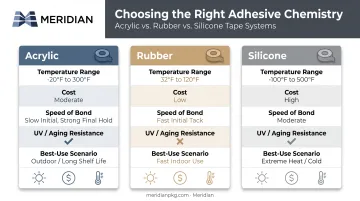
Nearly every industrial PSA tape relies on one of three adhesive chemistries: acrylic, rubber, or silicone. Each has a distinct performance profile, and picking wrong usually shows up later as failed seals or premature tape breakdown.
Acrylic Adhesives
Acrylic is the workhorse chemistry. It resists UV exposure, aging, and temperature swings, and it bonds to high, medium, and low surface energy materials. That gives it the broadest application range of the three (3M).
The trade-off: it builds to full bond strength more slowly than rubber. Meridian's standard and silent carton-sealing tapes both use acrylic BOPP construction for this reason.
Rubber Adhesives
Natural and synthetic rubber adhesives grab fastest and cost the least. They're the go-to for masking tape and everyday carton sealing. The downside is durability. Rubber degrades faster under UV and oxidation exposure, so it's a poor fit for long-term outdoor use or extended storage.
Silicone Adhesives
Silicone tapes handle extreme temperatures, from -40°F to over 500°F. They also bond to silicone surfaces and other very-low-energy materials that acrylic and rubber struggle with (3M).
That performance comes at a higher price. Silicone tape underperforms on standard, non-silicone substrates compared to the other two chemistries.
Quick decision guide:
- Outdoor exposure or long shelf life → acrylic
- Fast-turnaround, cost-sensitive, indoor use → rubber
- Extreme heat/cold or bonding to silicone → silicone
Common Types of Pressure-Sensitive Tape and Their Uses
PSA tape isn't one product. It's a category with distinct varieties built for specific jobs.
- Box-sealing tape — BOPP film with acrylic or synthetic rubber adhesive, used for carton sealing in warehouses and fulfillment centers
- Masking tape — crepe paper backing with a moderate-tack adhesive, used for painting, surface protection, and temporary holds
- Duct tape — cloth and poly construction, built for HVAC sealing and heavy-duty repairs
- Electrical tape — PVC backing with rubber-resin adhesive, often UL Listed for insulation work
- Double-sided tape — tissue or film carrier coated on both faces, used for mounting displays and signage
- Filament/strapping tape — reinforced with fiberglass or continuous filament for bundling and heavy holding tasks
Masking Tape in Detail
Masking tape deserves a closer look because it's one of the most misused products on this list. Its crepe paper backing stretches and conforms around corners, while its adhesive is formulated specifically for clean, residue-free removal. That's what separates it from box-sealing tape: masking tape is designed to come off without tearing paint or leaving gunk behind, not to hold permanently.
What "Scotch Tape" Actually Means
A lot of buyers use "Scotch tape" as a catch-all term. Scotch is a registered trademark of 3M, not a generic industry term. And there isn't one single "Scotch tape" construction.
Scotch Transparent Film Tape 605 uses BOPP backing with acrylic adhesive, while Scotch Box Sealing Tape 371 uses BOPP with synthetic rubber adhesive. Same brand name, two different chemistries built for two different jobs.
Choosing the Right PSA Tape for Your Business
Picking tape by price alone is how businesses end up with reseal complaints and damaged freight. A few factors matter more than sticker price.
Evaluate these before standardizing on a SKU:
- Surface energy of the substrate (cardboard, plastic film, metal, low-energy poly)
- Temperature range during storage and transit, including cold storage and summer trailer heat
- Indoor vs. outdoor exposure, which affects UV and humidity resistance needs
- Load and dynamic stress, such as vibration during long-haul shipping or repeated flexing
Don't take a spec sheet's word for it. Test the tape under your actual operating conditions, whether that's a cold storage dock running at 34°F or a humid Gulf Coast warehouse. A tape that works in a climate-controlled lab can fail within days in the field.
Once you know what holds up in your environment, treat tape like any other strategic indirect-spend category, not an afterthought.
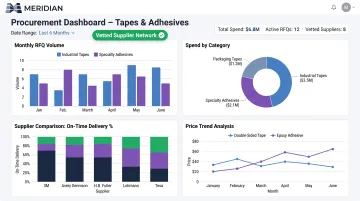
Meridian's procurement platform applies the same RFQ automation and spend analytics used for pallet optimization to tape and adhesive purchasing. Buyers get access to a network of 2,400+ vetted suppliers, centralized quote comparisons, and SKU-level spend visibility.
Industry Standards and Sustainability Considerations
Tape performance isn't just marketing language. It's measured against published standards from PSTC, ASTM International, and ISO.
| Property | ASTM Standard | ISO Standard |
|---|---|---|
| Peel adhesion | D3330/D3330M | ISO 29862:2018 |
| Shear strength | D3654/D3654M | ISO 29863:2018 |
| Tack (loop tack) | D6195 | Not standardized under ISO |
Ask suppliers which test method backs their published specs. A tape rated for shear strength under D3654 gives you a comparable, apples-to-apples number against competing products.
Performance specs are only half the decision for many buyers—environmental impact matters too. Film-backed box-sealing tapes generally don't hinder standard corrugated recycling streams when boxes go through repulping. Suppliers also offer recycled-content backings and paper-based alternatives for lower-impact programs.
"Recyclable" and "recycled-content" are not the same claim. Check the specific product's documentation rather than assuming based on the category.
Frequently Asked Questions
What is pressure-sensitive tape used for?
PSA tape is used for packaging and carton sealing, masking, electrical insulation, mounting and bonding, and general industrial assembly. Manufacturing, logistics, and retail operations rely on it heavily.
What is pressure-sensitive Scotch tape?
Scotch is a registered 3M brand name, not a generic term. Different Scotch products use different chemistries, ranging from acrylic film tape for office use to rubber-adhesive tape for box sealing.
What is pressure-sensitive adhesive masking tape?
Masking tape uses a crepe paper backing and a moderate-tack adhesive engineered for clean removal without residue. It's primarily used for painting, surface protection, and temporary bonding.
How is pressure-sensitive tape different from heat- or water-activated tape?
PSA tape bonds instantly with light pressure and needs no activation step. Water-activated (gummed) and heat-activated tapes need moisture or heat before they bond.
What should businesses consider when choosing PSA tape for shipping and packaging?
Factor in surface energy of the packaging material, temperature and humidity in transit, and the load or stress on the seal. Real-condition testing beats relying on a spec sheet alone.
Is pressure-sensitive tape recyclable or eco-friendly?
Most film-backed box-sealing tapes don't interfere with standard corrugated recycling processes. Recycled-content and paper-based tape options are increasingly available for buyers prioritizing sustainability.