Introduction
Every pallet that leaves a warehouse needs film. That single fact drives real cost, labor, and risk across a facility's operation.
Many packaging buyers struggle with the same questions: What's the real difference between standard and pre-stretched film? Why does one roll cost more upfront but less per pallet? And how do you know which film actually works with your equipment?
Get the answer wrong, and you either overspend on material or end up with a load that shifts in transit. Manual wrapping adds another cost: repeated lifting, reaching, twisting, and bending that strain backs, shoulders, and necks on the warehouse floor.
This guide breaks down what pre-stretched film is, how it stacks up against standard and power pre-stretch alternatives, and where each type belongs on your floor. You'll also see how enterprise buyers can control stretch film spend without gambling on load safety.
Key Takeaways
- Pre-stretched film is factory-elongated, so it needs little added stretch on application—unlike standard film.
- Hand and machine (power pre-stretch) films suit different equipment and cannot be swapped safely.
- Case studies show optimized stretch-wrapping systems cutting film use by 26-29%.
- Match film to load type, method, and volume; high-volume buyers gain leverage through strategic sourcing.
What Is Pre-Stretched Film?
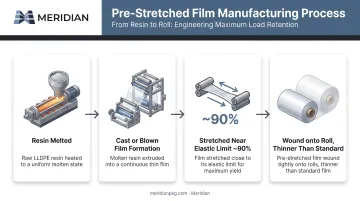
Pre-stretched film is stretch wrap that's elongated during manufacturing, before it ever gets wound onto a roll. That pre-stretching happens in the machine (longitudinal) direction, which is why the film comes off the roll noticeably thinner than standard stretch wrap of comparable strength.
Resin is melted and formed into film through either a cast process (extruded onto chill rollers) or a blown process (formed into a tube and inflated into a bubble before cooling). From there, factory pre-stretched film gets pulled to near its elastic limit before winding, while standard film is wound with no pre-stretch at all.
The memory effect and its limits
Because the film has already been stretched close to its capacity, it wants to contract once applied. That contraction is what tightens the wrap around a load and helps hold it in place through handling and transit.
Factory pre-stretch levels often approach 90%, though the exact figure varies by manufacturer, resin blend, and film gauge. There's no single verified industry-wide number. What is well documented is the ceiling on that stretch:
- Once film is pulled past its elastic limit, it undergoes strain hardening: permanent deformation that leaves less remaining stretch capacity.
- Pulling an already pre-stretched film further risks tearing rather than adding containment force.
- Research in the Journal of Applied Packaging Research found compressive force in tested films dropped by roughly 16% within two hours after excessive secondary stretching.
Standard film, by contrast, arrives at full thickness and full raw material weight. It relies entirely on the operator's arm strength or the wrapping machine's tension settings to achieve any elongation at all — which is exactly why it uses more plastic per pallet.
Standard vs. Pre-Stretched vs. Power Pre-Stretch Film
Not all "stretch film" behaves the same way, and the labels get confusing fast. The real difference comes down to where the elongation happens — before the sale, or during application.
Key Differences in Production and Application
Standard (conventional) film leaves the plant unstretched. You apply the stretch by hand or with a basic core-brake wrapper at the point of use.
Power pre-stretch film is slit and wound straight off the extrusion line with no factory stretching. It is built to elongate later inside a wrapping machine with dual rollers spinning at different speeds. Pre-stretched film skips that step entirely and arrives already stretched close to maximum elasticity.
Performance is comparable between the two when each is matched to the right equipment. The differences show up in production, force requirements, and use case:
| Film Type | When It's Stretched | Equipment Needed | Typical Use Case |
|---|---|---|---|
| Conventional/standard | At the point of application (hand or machine) | Hand or core-brake machine | Manual wrapping, low-throughput lines |
| Factory pre-stretched | Before winding, at the manufacturer | Hand or core-brake (non-powered) machine | Low-to-medium volume, irregular loads |
| Power pre-stretch | During application, via powered rollers | Automated pre-stretch wrapper | High-throughput, automated lines |
Documented equipment ratios illustrate how much stretch a powered carriage actually applies. Lantech's QL400XT specification lists a 250% pre-stretch ratio. Robopac's carriage guide puts the range at 100% to 400%, depending on the model. Hand-wrapping alone typically delivers only 1% to 20% elongation.
Risks of Mismatched Film and Equipment
Running the wrong film through the wrong machine causes two very different failures:
- Power pre-stretch film on a core-brake machine — the film never gets its intended elongation, so you burn through more material and lose the holding force that stretch was supposed to provide.
- Pre-stretched film through a power pre-stretch machine — the film is already near its breaking point, so the machine's rollers can snap it almost immediately.
If you're not sure which film you're holding, use a quick hand test: pull it. Film that stretches a long distance before it tightens is likely power pre-stretch. Film that tightens after only a short pull is likely factory pre-stretched.
When in doubt, confirm with your supplier. Guessing wrong gets expensive fast.
Types of Pre-Stretched Film and Where They're Used
Not every operation needs the same pre-stretched film. Matching the type to your application method and load profile is where most of the cost savings actually come from.
Hand-applied pre-stretched film works best for:
- Low-to-medium volume operations without automated wrapping equipment
- Irregularly shaped or mixed loads that need manual adjustment
- Warehouse teams where reducing pulling force and grip strain matters
Machine-applied pre-stretched film fits:
- High-throughput facilities running automated or robotic wrap stations
- Operations that need consistent, repeatable tension pallet after pallet
- Lines where labor cost per pallet needs to stay predictable
Beyond application method, choose variants based on load conditions and handling needs:
- Gauge thickness: Factory pre-stretched film often runs in the mid-20s to ~50 gauge (for example, Amcor Pre-Empt hand film at 26–38 gauge), much thinner than standard stretch rolls.
- UV-protected film: Includes a UV inhibitor for loads stored outdoors or in prolonged sunlight.
- Colored or opaque film: Supports load ID, inventory separation, or keeping contents out of view.
- Cast vs. blown: Blown film usually brings higher puncture resistance and cling; cast film unwinds more quietly and resists tear propagation.
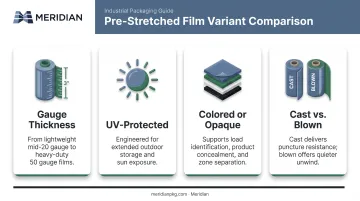
Meridian stocks hand-applied 60- and 80-gauge LLDPE film by the case for manual wrapping, plus a machine-oriented pre-stretched roll (20 in x 6,000 ft) for automated lines. UV-inhibitor and colored options cover facilities with tighter load or visibility requirements.
Key Benefits of Switching to Pre-Stretched Film
The case for pre-stretched film rests on a handful of measurable advantages backed by facility data and safety guidance.
Documented case studies show real reductions from optimized wrapping systems. IPG's Gear Up program recorded a 29% film savings and roughly $92,000 in annual savings for one facility. Lantech's beverage-industry case documented about 26% less film per pallet. Results like these come from combining the right film with properly tuned equipment, not from a film swap alone.
Shops also see gains beyond material cost:
- Less pulling force for hand application, addressing OSHA concerns about repetitive wrapping motions and musculoskeletal injury risk (lighter, narrower rolls are a named abatement measure)
- No neck-down: oriented and folded-edge pre-stretched film holds a more consistent width, so you need fewer passes per pallet
- Stronger containment from the memory effect, which contracts after application and stays tight through transit bumps and shifts
- Less roll waste, because reinforced or hemmed edges resist drops and edge tears that scrap standard rolls early
- Automation-ready performance from uniform thickness and predictable stretch on robotic wrap systems
Pre-Stretched Film Costs and How to Source the Right Solution
Price-per-roll is the wrong place to start. A cheaper roll that fails on a fragile or irregular load costs far more in damaged product and freight claims than it ever saved on material.
Evaluate these variables before you buy:
- Film gauge — thinner isn't always weaker with pre-stretched film, but gauge still needs to match load weight and edge sharpness
- Roll length and weight — affects how often operators change rolls and how much labor time that consumes
- Application method — hand-applied vs. machine-applied film are not interchangeable, as covered above
- Order volume — bulk pricing shifts meaningfully at higher case or pallet quantities
Selection criteria that matter as much as price:
- How irregular or unstable are your typical loads?
- Do you need puncture or tear resistance beyond standard formulations?
- Will loads be stored or shipped outdoors, requiring UV protection?
- Does your existing equipment have pre-stretch capability, or are you running a core-brake or hand-wrap setup?
For a facility spending a few hundred dollars a month on film, these decisions are manageable in-house. For mid-to-large enterprises managing stretch film as one line item inside a much larger indirect packaging spend, the decision gets more complex.
This is where a network approach earns its keep. Meridian Packaging works with 2,400+ trusted partners across the country, so enterprise buyers can get competitive quotes on hand-applied, machine-applied, UV-protected, and colored stretch film without juggling a dozen supplier relationships.
Its RFQ platform routes film specifications to matching suppliers. Clients report 75% more competitive quotes and up to 90% faster time to procurement as a result.
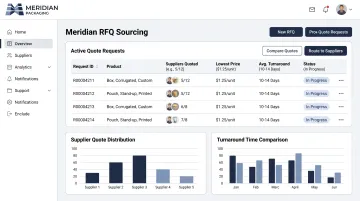
That matters most for companies treating packaging as a strategic spend category rather than a recurring purchase order — where guaranteed savings and supply continuity carry more weight than shaving a few cents off a single roll.
Frequently Asked Questions
How much does stretch wrap cost?
Cost varies by gauge, film type, roll size, and order volume. A 20-inch by 6,000-foot pre-stretched roll often costs more per roll than standard hand film, but uses less material per load so cost per pallet is usually lower.
What is stretch film used for?
Stretch film secures, unitizes, and protects palletized goods during storage, handling, and transit. It's used across manufacturing, distribution, retail, and logistics to keep mixed or stacked products stable and intact.
What are the different types of stretch film?
The main categories are hand film, machine (power pre-stretch) film, factory pre-stretched film, and cast vs. blown formulations. Specialty variants include UV-resistant film for outdoor storage and colored film for load identification.
Is stretch film the same as saran wrap?
No. Stretch film is a thicker, industrial-grade polyethylene built for load securing, while household cling wraps are formulated for food storage and use different resin blends entirely. They stretch, but they're engineered for very different jobs.
How do I know if my film is pre-stretched or power pre-stretch?
Try the hand-stretch test: pull the film. If it tightens up quickly after a short pull, it's likely factory pre-stretched. If it stretches a long distance before resisting, it's likely power pre-stretch film. When it matters, confirm with your supplier.
Does pre-stretched film work with all pallet wrapping machines?
No. Pre-stretched film is meant for hand application or core-brake machines without pre-stretch capability. Running it through a power pre-stretch machine can snap it, since it's already near its maximum elongation.