Introduction
Choosing between an RSC, HSC, FOL, or telescoping box shouldn't feel like guesswork, but for most warehouse and packaging teams, it does. Many buyers default to whatever style they used last time, without knowing how the flap structure actually affects cost, stacking strength, or protection.
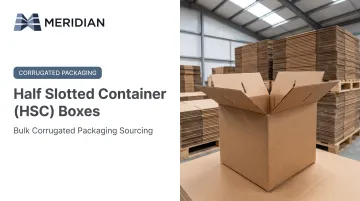
A Half Slotted Container (HSC) is an open-top corrugated box classified under FEFCO 0200. It's built with a full set of bottom flaps and no top flaps at all, which makes it a go-to option for storage, retail display, and bulk material handling.
This guide breaks down what an HSC is, how it compares to RSC and FOL styles, and where teams use it across industries. You'll also see when a standalone HSC works—and when a telescoping setup is the better fit.
Key Takeaways
- HSC boxes (FEFCO 0200) have sealed bottom flaps and an open top, ideal for storage and fast-access applications
- Vertical compression strength comes from the ECT rating of the side walls, not the top flaps
- RSC remains the standard shipping box; FOL trades material cost for extra stacking strength
- Standalone HSCs offer zero built-in dust, moisture, or tamper protection without a lid
- Gaylord boxes are large-format HSC variants built for palletized bulk handling
What Is a Half Slotted Container (HSC) Box?
An HSC is a Regular Slotted Container (RSC) with the entire top flap set removed. What's left is a container with four sealed flaps at the bottom and a clean, fully open top edge. It falls under the FEFCO 0200 series, the broader "slotted boxes" category that also includes the RSC and Full Overlap (FOL) styles.
How It's Built
The construction sequence is straightforward:
- Minor flaps fold first along the shorter box dimension
- Major flaps fold in and meet at the centerline, but only on the bottom
- The top edge stays open with no flaps and no scoring to close it
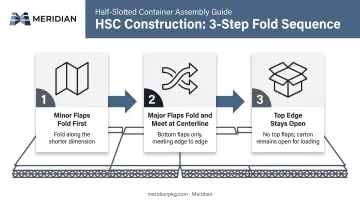
Because there's no top structure to engineer, HSCs use less board than a comparable RSC. That said, the savings show up mostly in flap material, not in the walls that actually carry the load.
Materials and Strength
Flute selection has a bigger impact on rigidity than most buyers expect:
| Flute Type | Typical Thickness | Best For |
|---|---|---|
| B-flute | About 1/8 in. | Rigid, flat printing surface; heavier individual items |
| C-flute | About 3/16 in. | General shipping and cushioning |
| BC double-wall | About 1/4–5/16 in. | Heavy or fragile loads needing extra crush resistance |
Removing the top flaps does not eliminate stacking capacity. Vertical compression strength comes primarily from the edge crush test (ECT) rating of the side walls and corners, not the top closure. A well-built HSC with a solid ECT rating can still stack safely without a lid, provided the load itself is stable.
What an HSC won't do on its own is protect contents from dust, moisture, or tampering. If any of that matters, you need a lid, tray, or a controlled storage environment on top of the base container.
At large scale, this same open-top design shows up as the Gaylord box, a bulk bin typically built on a 40 x 48 in. footprint for palletized shipping and storage of loose or semi-packaged materials.
HSC vs. RSC vs. FOL: Key Structural and Cost Differences
Flap geometry is where these three styles diverge, and it drives everything from material cost to stacking behavior.
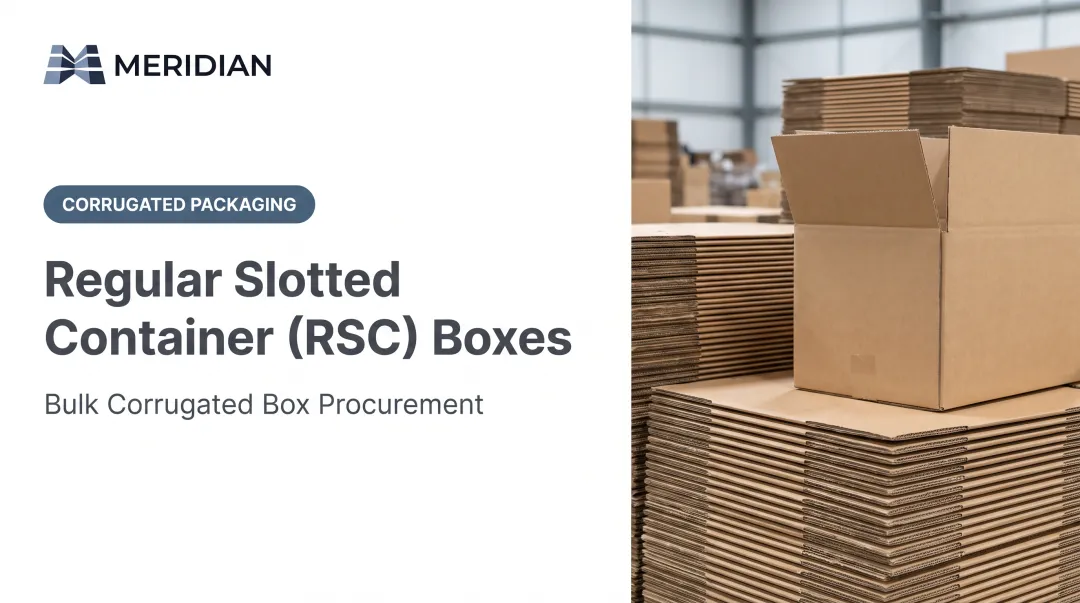
RSC (FEFCO 0201) is the most common box style in the industry, according to Packaging Corporation of America. All four flaps meet at the center on both the top and bottom, giving a fully enclosed, standardized shipping container.
FOL (Full Overlap, FEFCO 0203) extends the flaps so they nearly cover the entire top and bottom surface. This overlap adds cushioning and side-stacking strength, but it uses more board than an RSC, which pushes material cost higher.
HSC (FEFCO 0200) sits at the opposite end of the material spectrum. It costs slightly less than an RSC because there's no top flap set to produce. But that savings can disappear fast once you add a separate lid or telescoping cover, sometimes pushing total system cost above a standard RSC.
Comparing the Three Styles
| Feature | RSC (0201) | FOL (0203) | HSC (0200) |
|---|---|---|---|
| Construction | Flaps meet at center, top and bottom | Flaps nearly fully overlap, top and bottom | Bottom flaps only; open top |
| Closure Method | Standard flap fold | Overlapping flap fold | Requires separate lid/tray or none |
| Relative Cost vs RSC | Baseline | Higher (more board) | Lower (base only); higher if lidded |
| Best Use Case | Standard shipping | Heavy or fragile loads needing stacking strength | Open storage, display, lidded configurations |
| FEFCO Code | 0201 | 0203 | 0200 |
When to Choose Each
- RSC for general shipping where a standard enclosed box gets the job done
- FOL for heavy or fragile loads that need maximum stacking strength during rough handling
- HSC for open-access storage, retail display, or any setup pairing with a separate lid
Flap style alone tells you very little about actual stacking predictability. ECT and BCT (Box Compression Test) values matter far more. For critical applications, test to ISTA or TAPPI standards rather than assuming a box style guarantees a certain load capacity.
Common Applications and Industries Using HSC Boxes
HSC boxes show up anywhere fast top-access or open loading matters more than a sealed enclosure.
Retail and Shelf-Ready Packaging (SRP). HSCs move straight from pallet to shelf without a box cutter in sight. Store associates lift the box into place, and the open top does the rest, cutting down on restocking time and reducing the handling damage that comes from repeated cutting and repacking.
Telescoping cover configurations. Pairing an HSC base with a separate tray lid creates a two-piece system used in industrial equipment logistics, long metal extrusions, and architectural trim shipments where fast top access matters during handling or inspection.
Bulk material handling and Gaylord/pallet-based shipping. Large-format HSC and Gaylord containers sit directly on a pallet, consolidating loose or semi-packaged goods for warehouse storage and bulk transport.
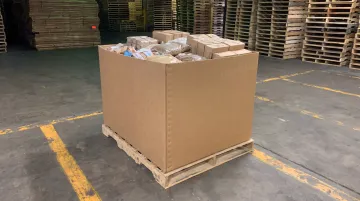
Open-top containers depend on a correctly sized, structurally sound pallet for load distribution. High-volume Gaylord programs often struggle to source consistent pallets at the same pace as their boxes. Meridian Packaging's network of 2,400+ partners supplies multiple pallet grades—including Grade A units rated up to 4,600 pounds—with next-day delivery in many markets.
Intralogistics and manufacturing. Reusable HSC bins move parts from workstation to workstation on production lines, standing up to repeated handling without the cost of a fully enclosed box.
Agricultural and produce handling. Ventilated telescoping HSCs protect fruits and vegetables from moisture damage while adding the stacking strength needed for cold-chain and air-freight conditions.
HSC vs. Telescoping Boxes: Which Do You Need?
A "telescoping box" isn't a different box style so much as two HSC-style trays working together. One tray, usually smaller, slides over or under the other to form a complete enclosure. A standalone HSC, by contrast, has no dedicated cover at all.
Standalone HSC works best when:
- Contents stay in a controlled, indoor storage environment
- Products move quickly in and out of open bins
- Dust, moisture, or tamper protection is not required
Telescoping configurations work best when:
- Items are fragile, flat, or premium and need a finished, presentable closure
- Products ship outdoors or through variable handling conditions
- Unboxing presentation matters to the end customer
The tradeoff comes down to material and labor versus protection. Telescoping designs use two separate pieces, which means more board and more assembly time than a single-piece HSC.
In exchange, you get a fully enclosed package with better protection and a cleaner unboxing experience. For a warehouse bin, that extra cost rarely pays off. For a shipped product reaching a retail customer, it often does.
Cost, MOQ, and Procurement Considerations
HSC unit cost typically runs lower than RSC because there's less board area to produce. The catch: once you add a lid, tray, or telescoping cover, total system cost can climb back above a standard RSC, sometimes past it.
MOQ and lead time vary significantly by supplier. Benchmarks from individual suppliers include:
- 500-unit minimum with a 15–20 business day turnaround (one custom-box supplier)
- 1–2 weeks for structural prototyping, plus added time for ISTA or ASTM validation
These are supplier-specific figures, not industry standards. Always confirm MOQ and lead time directly in your quote.
For reference, Meridian's own RSC corrugated box line carries a minimum order of just 1 bundle (15–25 boxes depending on size). That gap shows how widely MOQ policy differs by supplier and box style. Custom HSC lid configurations or drop-testing requirements typically add time beyond a stock box order.
HSC and Gaylord programs also depend on consistent pallet supply, so box cost is only part of the picture. Meridian offers a free spend analysis for companies spending $500,000 to $10 million-plus annually on pallet procurement. It helps quantify savings across the full palletized shipping and storage program, not the box alone.
How to Choose the Right HSC Box for Your Application
Start with the load, not the box style.
- Assess load type first. Rigid, load-bearing contents like bottles, cans, or machine parts can often ship in an open HSC without a lid. Fragile or flexible contents usually need a lid or slip sheet, at minimum on the top pallet tiers.
- Match the box to its environment. An open HSC works for controlled indoor storage and retail settings. Telescoping HSC configurations handle shipping, outdoor use, and variable conditions better.
- Evaluate reinforcement before upgrading board grade. H-dividers, corner posts, and grid partitions can boost compression strength cost-effectively, often cheaper than jumping to a heavier board across an entire run.
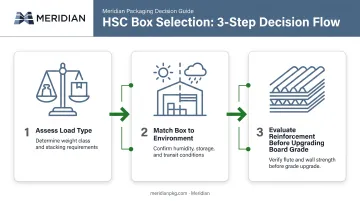
Getting this sequence right avoids over-speccing the box and paying for double-wall board you don't need. It also prevents under-speccing it and discovering a compression failure three pallets deep in a warehouse rack.
Frequently Asked Questions
What is the HS code for boxes?
Corrugated and paperboard boxes generally fall under HS code 4819.10.00, covering cartons and boxes of corrugated paper or paperboard. Confirm the exact subheading with a customs broker, since classification can vary by material and use.
What are the main types of corrugated boxes, and what do terms like RSC and FOL mean?
RSC (Regular Slotted Container) is the standard shipping box with flaps that meet at the center on top and bottom. FOL (Full Overlap) nearly doubles the top and bottom layers for extra strength. HSC has no top flaps; telescoping and die-cut styles cover specialty needs.
Can HSC boxes be stacked on pallets without a top cover?
It depends on the contents. Rigid, load-bearing items are often safe to stack bare, while fragile or flexible contents need a lid or slip sheet to distribute weight evenly across the top tier.
What's the difference between an HSC box and a Gaylord container?
A Gaylord is essentially a large-format HSC or bulk bin, built specifically for palletized bulk material handling. It follows the same open-top, bottom-flap construction, just scaled up for warehouse and industrial volumes.
Are there extra tooling costs when ordering custom HSC boxes?
Standard HSCs need no special tooling. Custom features like hand holes or crash-lock bottoms require a one-time die-cut fee, which varies based on the complexity and size of the design.
Which corrugated box type is strongest for shipping?
FOL offers the strongest single-wall option because of its near-full overlap on the top and bottom. Double-wall board in any box style, including HSC or RSC, adds significant crush resistance for heavier or longer shipments.