ECT drives product damage rates, shipping costs, carrier compliance, and even your sustainability numbers. Get it wrong in either direction, and you either eat damage claims or overspend on board you didn't need.
Right-sizing corrugated specs isn't theoretical. DS Smith reported a case where a packaging redesign cut corrugated material use by 23% and reduced void fill by 50%, according to its 2021 sustainability report. This guide breaks down what ECT actually measures, how to read the numbers, and how to choose a rating that protects your product without wasting your budget.
Key Takeaways
- ECT measures edgewise compression strength, or how much stacking force a box withstands before crushing
- Common ratings (23, 32, 44, and 48 ECT) correspond to different weight and stacking capacities
- Bursting (Mullen) strength tests puncture resistance—it is not a substitute for ECT
- Right-sizing ECT balances product protection against cost and material waste
- Real-world stacking performance also depends heavily on pallet condition, not the box alone
What Is ECT (Edge Crush Test)?
ECT stands for Edge Crush Test. It measures how much compression force a corrugated sheet can take before it buckles, expressed in pounds per linear inch (lb/in). The test is standardized under TAPPI T 811 in the US and ISO 3037 internationally.
You'll see ECT ratings in a few places:
- Box specification labels printed on the manufacturer's certificate stamp
- Carrier compliance documentation for regulated or high-value freight
- Procurement negotiations between buyers and corrugated suppliers
- Quality control checks verifying incoming board matches the purchase order
ECT vs. the Bursting (Mullen) Test
Before ECT became standard, most boxes were rated using the Bursting Test, also called Mullen. The two are often confused, but they measure different failure modes.
ECT tells you how much stacking or compression force a box can handle. Mullen tells you how much force it takes to puncture or rupture the board. They are not interchangeable, and a box optimized for one doesn't automatically perform well on the other.
Why ECT Ratings Matter in Corrugated Packaging
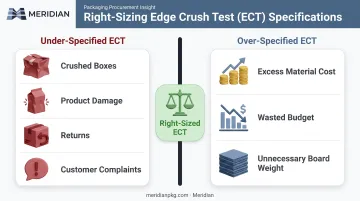
Picking the wrong ECT rating creates two expensive problems, and both hit your bottom line.
- Under-specify the board, and boxes crush under normal stacking, leading to product damage, returns, and customer complaints
- Over-specify it, and you're paying for board strength your shipment will never use, quarter after quarter, across thousands of cartons
This isn't only a quality issue. Carriers build ECT thresholds directly into their acceptance rules. UPS's hazardous materials guidance, for example, requires packages to use a minimum 200# burst or 32 ECT certified box for regulated shipments.
Broader parcel weight tables from carriers exist too, though they function as guidelines rather than blanket mandates. Confirm current requirements with your specific carrier contract.
For procurement teams managing packaging across multiple SKUs, ECT selection becomes a recurring negotiation point with suppliers. A board rated correctly for the actual shipment weight, rather than padded "just in case," tends to use noticeably less fiber per carton over a full year of orders.
How ECT Is Calculated & What the Numbers Actually Mean
The physical test is simpler than the science behind it sounds. A small board sample gets compressed on its edge between two rigid plates, positioned perpendicular to the flutes, until it buckles. The peak load right before failure is recorded as the ECT value in lb/in.
Flute type and wall count both influence what ECT rating a board can achieve, because they change how much vertical support the fluted medium actually provides:
- A-flute and larger profiles generally offer more cushioning and vertical compression support
- B and E-flute trade some strength for better print graphics and thinner profiles
- Single, double, and triple-wall constructions add layers of liner and medium, increasing achievable ECT
Flute letter alone doesn't guarantee a specific ECT number. The finished board, liner quality, medium, and how it's converted all factor into the final tested result.
Common ECT Ratings and What They Mean
Here's a general reference for how ratings map to typical use cases. Treat these as starting points for design screening, not guaranteed capacities, since supplier charts vary:
| ECT Rating | Approximate Weight Capacity | Typical Use Case |
|---|---|---|
| 23 ECT | ~20 lbs | Light products, single-wall |
| 32 ECT | ~65 lbs | Industry standard, general shipping |
| 44 ECT | ~95 lbs | Heavy-duty, often double-wall |
| 48 ECT | 100+ lbs | Double-wall, heavy-duty stacking |
What does 44 ECT actually mean? It indicates the board withstood 44 lb/in of edgewise compression in testing. Commercial supplier charts commonly pair 44 ECT with a 275# Mullen rating, but that is a chart pairing, not a mathematical conversion. The two tests measure different failure modes entirely. Always verify against your specific supplier's chart before finalizing a spec.
Keep these caveats in mind before you lock in a number:
- ECT values are minimums. The same nominal rating can perform slightly differently between corrugators, since each runs its own board "recipe."
- Humidity weakens fiber. A Clemson University study found compression strength dropped ~7% for every 1-point rise in board moisture (tested across 30%–90% RH)—critical for outdoor storage, humid climates, and long-haul lanes.

Meridian's own corrugated line reflects this same tiering, offering ECT-32 single-wall boxes for light-to-medium loads and ECT-44 double-wall boxes for heavier, stacked applications.
How to Choose the Right ECT for Your Boxes
Selecting an ECT rating takes a short sequence of checks. Walk through these before you commit to a bulk order.
- Calculate total shipment weight. Add product weight, packaging weight, and any void fill together. This is your starting benchmark, not the final answer.
- Match ECT priority to shipping method. Palletized or LTL shipments should prioritize ECT—stacking strength matters most. Parcel shipments need burst strength weighed equally; they take more handling impacts than compression.
- Factor in stacking height and duration. Boxes at the bottom of a pallet carry the most cumulative load, especially during long storage periods before shipping.
- Account for environmental exposure. Humidity and temperature swings weaken corrugated fiber over time, so lanes through humid regions may need a higher ECT buffer.
- Order physical samples first. Test the shortlisted ECT and flute combination in real conditions before committing to volume pricing.
The most common mistake? Assuming higher ECT is always better. Over-specifying wastes money on lightweight products or short-haul shipments that never see real compression stress. Match the spec to the actual shipment, not a worst-case scenario that rarely happens.
Beyond the Box: Why Pallet Quality Also Affects Your ECT Performance
Here's something that trips up a lot of procurement teams: ECT ratings are tested and certified assuming a flat, stable supporting surface underneath. In an actual warehouse or trailer, that surface is the pallet.
A warped deck board, a broken stringer, or inconsistent pallet decking creates uneven pressure points. Even a correctly-rated ECT box can buckle prematurely under those conditions, undermining the money you just spent getting the spec right.
This is where pallet sourcing becomes a packaging performance issue, not just a logistics one. Meridian works with a network of 2,400+ vetted pallet suppliers nationwide, screened for reliability, quality, compliance, and structural integrity. That way, the pallets under your corrugated shipments hold up the way your ECT specification assumes they will.

For high-volume palletized loads, Meridian typically recommends:
- Grade A pallets for heavy-duty, multi-trip operations, rated up to 4,600 lbs
- Grade B pallets for budget-conscious, high-volume distribution, with a minimum 2,500-lb GMA capacity
If you're not sure whether your current pallet program is working against your packaging investment, Meridian's free US spend analysis gives procurement teams a no-cost baseline. You'll see current pallet spend and where fragmentation is costing more than it should.
Frequently Asked Questions
What does 44 ECT mean and what is it equivalent to?
44 ECT means the board withstood 44 lbs of edgewise compression per linear inch in testing. Supplier charts commonly pair it with a 275# Mullen rating for heavier shipments around 90–95 lbs—a chart pairing, not a direct conversion.
How is ECT calculated?
Lab testing compresses a corrugated sample edgewise between two plates, perpendicular to the flutes, until it buckles. The peak force right before failure is recorded in lb/in as the ECT value.
What's the difference between ECT and the Mullen burst test?
ECT measures stacking and compression strength, while Mullen measures puncture and rupture resistance. The two ratings test different failure modes and aren't directly interchangeable.
What ECT rating do I need for my boxes?
It depends on total shipment weight, stacking height, and shipping method. Start with 32 ECT as a baseline for standard parcel shipments, and move to 44+ ECT for heavier or palletized loads.
Does a higher ECT always mean a stronger, better box?
Higher ECT means more stacking strength, not necessarily better puncture resistance. Over-specifying for light products adds cost without meaningful protection.
How does humidity affect ECT ratings?
Moisture absorption weakens corrugated fibers and reduces effective compression strength. For humid climates or outdoor storage, specify a higher ECT buffer or add protective measures.