Introduction
Nobody notices packaging adhesive until it fails. A box pops open on a conveyor belt. A label peels off in a cooler. A pouch delaminates before it ever reaches a shelf.
These small failures carry real costs, and they're becoming more common as e-commerce volumes climb and flexible packaging formats multiply.
The category itself is massive and still growing. Smithers values the global packaging and label adhesives market at $21.6 billion and 7.2 million metric tons in 2025, with value expected to climb to $25.7 billion by 2030.
Choosing the wrong adhesive isn't a minor line-item mistake. It leads to pop-opens, delamination, damaged goods in transit, and reprint costs that eat into margins fast. This guide breaks down the main adhesive types, how to choose between them, the specific demands of flexible packaging and lamination, and where the category is headed next.
Key Takeaways
- Match adhesive choice to substrate, line speed, environment, and any food-contact rules before you buy.
- Water-based grades still lead on volume; hot melt and acrylic options are the fastest-growing picks for speed and bond strength.
- Treat flexible packaging and laminating adhesives as a separate decision from rigid carton or case sealing.
- Spec bio-based, compostable, or recyclable-compatible formulas when end-of-life and sustainability targets matter.
Types of Adhesives Commonly Used in Packaging
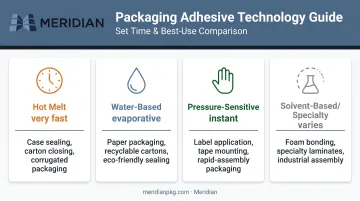
Most packaging adhesives fall into four technology families. Each one bonds differently, sets at a different speed, and fits different production environments. Picking the right family is the first decision — everything else builds from there.
| Adhesive Type | Set Time | Best For |
|---|---|---|
| Hot Melt | Very fast | Case/carton sealing, high-speed lines |
| Water-Based | Slower (evaporative) | Paper-to-paper bonding, labeling |
| Pressure-Sensitive | Instant | Labels, resealable packaging |
| Solvent-Based/Specialty | Varies | Lamination, temporary bonds |
Hot Melt Adhesives
Hot melts are 100% solid thermoplastics — no water or solvent carrier — applied molten through glue guns or bulk dispensing systems. They're heated to roughly 50-160°C, wet the substrate, then solidify in seconds. Common packaging chemistries include EVA, polyolefin, and metallocene formulas.
Where they shine:
- Case and carton sealing on automated lines
- Tamper-resistant seals
- Applications where speed matters more than upfront equipment cost
The trade-off? You need heated application equipment, and that's a capital investment most manual or low-volume operations skip. Meridian supplies hot-melt carton sealing tapes built for this kind of high-throughput sealing.
Water-Based Adhesives
Water-based adhesives, including latex, starch, resin, and acrylic formulas, cure as water evaporates or absorbs into the substrate. They're inexpensive, clean up easily, and generally meet food-contact requirements with minimal extra certification work.
The catch is dry time. These adhesives take longer to set than hot melts, and older formulations struggled in humid environments. Newer packaging-grade water-based adhesives claim improved heat and moisture resistance, so blanket "humidity kills water-based glue" assumptions don't hold up the way they used to. You'll find them most often in:
- Board and case lamination
- Paper bag and carton assembly
- Food and confectionery labeling
Pressure-Sensitive Adhesives (PSA)
PSAs bond on contact — no heat, water, or solvent activation needed. Apply pressure, and you've got an instant, permanently tacky bond. That's what makes them the default choice for labels, resealable packaging, and bookbinding.
PSAs are gaining ground fast in resealable food, beverage, and personal care formats, where consumers expect to open and reclose packaging repeatedly without losing bond integrity. One limitation: tack can drop off at low temperatures, and shear strength can weaken at high heat, so PSA selection still needs to match the shipping and storage environment.
Solvent-Based & Specialty Adhesives
This bucket covers fugitive glues (temporary, clean-release bonds for coupons, samples, and inserts) and traditional solvent-based polyurethane adhesives used in film lamination.
Solvent-based systems are losing ground. VOC regulations have pushed manufacturers toward solvent-free alternatives across most applications, and that shift is continuing. For food packaging, toxicology and residual-solvent concerns make solvent-free formulations the safer long-term bet.
How to Choose the Right Packaging Adhesive
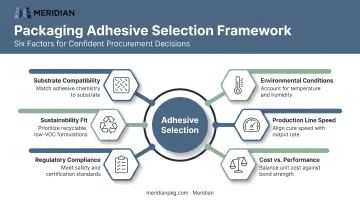
Six factors decide whether an adhesive performs or fails in the field. Skip any one of them during selection, and you're gambling on a bond that might not hold.
Substrate compatibility. Not every adhesive bonds equally well to every surface. High-surface-energy materials like PET and glass accept adhesive readily; low-surface-energy plastics like HDPE resist it. Metallized film, uncoated stock, and UV-coated paper each bring their own bonding challenges. Match the adhesive to the substrate; guessing here is how seals fail.
Environmental conditions. Temperature and humidity swings during shipping and storage can cause an adhesive that tested fine in the warehouse to fail in transit. Cold-chain shipments are a good example: Bostik's Thermogrip H2259-01, a freezer-grade hot melt PSA, is rated for application down to -15°F, built specifically for labels on frozen food packaging.
Production line speed. Fast automated lines need fast-curing adhesives: usually hot melt or PSA. Manual or lower-volume operations have more flexibility to use slower-setting, lower-cost water-based options.
Cost versus performance. The cheapest adhesive per gallon isn't automatically the best value. Factor in:
- Equipment costs (heated systems vs. cold application)
- Waste and rework rates
- Line speed compatibility
- Long-term supply reliability
Regulatory and food-safety compliance. In the US, 21 CFR 175.105 governs food-packaging adhesives, requiring approved substances and either a functional barrier or strict contact limits. In the EU, Regulation 10/2011 sets migration limits and documentation requirements for adhesives used in plastic food-contact multilayers.
Neither rule is a rubber stamp. Compliance takes documentation and testing.
Sustainability fit. Brand owners increasingly demand adhesives compatible with recycling streams. Avery Dennison's AD CleanFlake technology, for example, separates cleanly during PET recycling so label adhesive doesn't contaminate the recycled flake. That detail matters far more now than it did five years ago.
Best Adhesives for Flexible Packaging & Laminating
Flexible packaging (pouches, films, wraps) is the fastest-growing packaging format in the US. The Flexible Packaging Association identifies it as the second-largest and fastest-growing US packaging segment, generating over $51.5 billion in annual sales.
That growth brings different adhesive requirements: flexible formats need performance that rigid boxes and cartons never demand.
Adhesives That Flex and Hold
Flexible pouches and wraps need adhesive that flexes without cracking, holds up under repeated handling, and often meets food-contact standards. The most common choices:
- PSAs and water-based acrylics: Balance flexibility, resealability, and food safety for pouches and wraps
- Hot melts for flexible substrates: Built for high-speed pouch-forming lines where seal integrity at speed is critical
- Cold-seal adhesives: Enable pressure-only sealing on heat-sensitive snack and confectionery films
Laminating Adhesives for Flexible Packaging
Laminating adhesives bond the film, foil, and paper layers that give flexible packages their barrier properties. This is where the industry's VOC-driven shift shows up most clearly.
Henkel's Loctite Liofol LA 7837/LA 6265, launched in 2025, is a solvent-free aliphatic adhesive built for high-thermal-stress retort packaging, including PET/foil/CPP pet-food packs. Henkel reports under 0.1% residual monomer and resistance to temperatures up to 134°C.
Solventless polyurethane lamination works through an isocyanate-functional prepolymer reaction that skips the solvent carrier entirely. That removes energy-intensive drying ovens and cuts VOC emissions. Some solventless systems reach full FDA-compliant cure in as little as two days.
Common Applications for Packaging Adhesives
Adhesive choice varies dramatically by application, even within the same facility.
Carton and case sealing relies mostly on hot melt for speed on automated lines. Water-based adhesive is still common on corrugated side seams and some carton bottoms. Meridian's Standard and Silent Carton Sealing Tape use an acrylic BOPP construction built for everyday case-sealing work.
Labeling (bottle, can, and product labels) relies on PSA and water-based acrylic. These formats need instant tack without heat activation on the line.
Bags, pouches, and specialty formats (cups, envelopes, honeycomb packaging) often require niche formulations. Water-activated tape, for example, uses reinforced kraft paper for a bond that strengthens over time. That durability helps shipments survive rough handling.
Sustainability & Emerging Trends in Packaging Adhesives
Two forces are reshaping adhesive formulation right now: recyclability pressure and e-commerce growth.
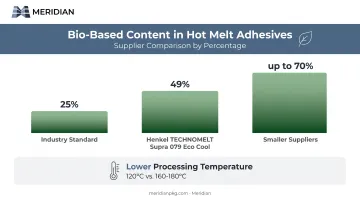
Bio-based and compostable formulations are moving from niche to mainstream. Smithers reports that multiple major suppliers now offer hot melts with at least 25% bio-derived content, and some smaller suppliers push that as high as 70%.
Henkel's TECHNOMELT Supra 079 Eco Cool combines 49% directly bio-based material with mass-balance certification, and processes at 120°C instead of 160-180°C. That temperature drop is a meaningful energy reduction across a production run.
E-commerce is driving demand for cold-resistant, fast-set hot melts built for tamper-evident shipping packaging. Dry-ice shipments and hot-climate delivery routes both stress adhesive performance in ways room-temperature testing never catches.
Adhesive isn't the only overlooked line item in a packaging budget. Enterprises optimizing adhesive spend for cost and sustainability often apply the same scrutiny to other indirect categories, pallets included.
Meridian works with mid-to-large enterprises on that front, using a nationwide network of 2,400+ partners to bring competitive sourcing discipline to pallet spend the same way buyers now expect it from adhesive suppliers.
Frequently Asked Questions
What are good flexible adhesives for packaging?
Pressure-sensitive adhesives (PSAs) and water-based acrylics are strong options for flexibility and resealability in pouches and wraps. Hot melts engineered for flexible substrates handle high-speed pouch-forming lines where seal integrity at speed is critical.
What are some good laminating adhesives for flexible packaging?
Solvent-free polyurethane laminating adhesives suit multi-layer film structures that need food-contact compliance. They eliminate VOC emissions while still delivering strong interlayer bonds.
What types of adhesives are commonly used in packaging?
The four main categories are hot melt, water-based, pressure-sensitive, and solvent-based/specialty adhesives. Each fits different substrates, speeds, and application methods across the packaging industry.
What is the difference between hot melt and water-based adhesives?
Hot melt sets in seconds but requires heated application equipment, making it ideal for high-speed lines. Water-based adhesives cost less and clean up easily but take longer to dry as the water evaporates.
Are packaging adhesives safe for food contact?
Yes, when they meet FDA regulation 21 CFR 175.105 or EU Regulation 10/2011 requirements. These rules require approved substances, migration limits, and either a functional barrier or fully cured, non-toxic formulations.
How do you choose the best adhesive for corrugated boxes?
Automated, high-speed lines typically favor hot melt for its fast set time and strong bond strength. Lower-volume or manual operations can use water-based adhesives, which cost less but take longer to cure.