Introduction
E-commerce sales across 43 major economies climbed nearly 60% between 2016 and 2022, hitting $27 trillion, according to a 2024 UN Trade and Development report.
That growth rides on packaging—and global plastic waste is climbing with it. The OECD projects a nearly threefold jump from 353 million metric tons in 2019 to over 1 billion by 2060.
Businesses now face pressure from two directions at once. Customers expect greener boxes. Regulators are writing deadlines into law. Neither group wants you to sacrifice product protection or blow your shipping budget to get there.
This article breaks down what eco-friendly packaging actually means, which biodegradable materials hold up in real shipping conditions, and a piece of the sustainability puzzle most companies overlook entirely: pallets.
Key Takeaways
- Eco-friendly packaging spans biodegradable, compostable, recyclable, and reusable materials, each with distinct disposal outcomes
- Choose certified compostable materials (BPI, ASTM D6400, or EN 13432) over generic "biodegradable" claims for reliable breakdown
- Paper, molded fiber, mycelium, bagasse, and hemp are strong plastic alternatives for boxes and void fill
- Treat pallets and shipping infrastructure as part of end-to-end sustainability, not an afterthought
- Match material choice to product protection, local disposal access, and cost at volume
What Is Eco-Friendly Packaging?
Eco-friendly packaging refers to materials and design choices that reduce environmental harm at every stage: sourcing, use, and disposal. It's a broader concept than "made from plants" or "recyclable" alone.
Whether something biodegrades depends on its molecular structure, not its origin. Paper and cellulose have weak carbon chains that microorganisms can break apart easily. Conventional plastics like PE, PET, and PP have strong, tightly bonded chains that resist breakdown for decades, regardless of what a package label implies.
That distinction matters because "biodegradable" gets used loosely. A material technically qualifies if it eventually breaks down, even if that takes 50 years in a landfill with zero oxygen. Without certification, the term tells you almost nothing about real-world timelines.
Biodegradable vs. Compostable vs. Recyclable vs. Reusable
These four terms get used interchangeably, but they describe different processes with different results:
- Biodegradable — Broken down by microorganisms into water, CO2, and biomass; timelines range from weeks to centuries
- Compostable — Certified subset of biodegradable that becomes nutrient-rich soil under controlled conditions, usually within 6 months industrially
- Recyclable — Reprocessed into new materials; not all biodegradable items are recyclable, and aluminum is recyclable but not biodegradable
- Reusable — Built for multiple use cycles before disposal, cutting demand for new material
The most reliable way to separate genuine claims from marketing noise: check for certification.
| Certification | What It Verifies |
|---|---|
| BPI | Third-party commercial compostability certification (ASTM D6400) |
| ASTM D6400 | U.S. spec for plastics designed for industrial or municipal composting |
| EN 13432 | EU standard: 90% biodegradation within 6 months under controlled composting |
If a package lacks one of these marks, treat "biodegradable" as an unverified claim, not a guarantee.
Why Businesses Are Switching to Eco-Friendly Shipping Boxes
Consumer demand isn't a soft trend anymore. A 2023 Trivium Packaging survey of more than 9,000 consumers found 82% would pay more for sustainable packaging.
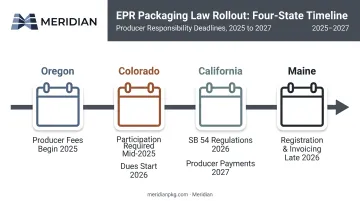
Regulation is closing the gap between "nice to have" and "mandatory." Extended producer responsibility (EPR) laws are already active or approaching enforcement:
- Oregon — Producer fees began in 2025
- Colorado — Participation required as of mid-2025, dues starting 2026
- California — SB 54 regulations take effect in 2026, with producer payments starting 2027
- Maine — Registration and invoicing anticipated late 2026
Waiting until a deadline hits leaves teams scrambling to qualify materials, update labeling, and absorb new fees.
Early adopters also win on brand and cost. Sustainable packaging stands out at the shelf and in the inbox. Over time, lighter materials and less void fill trim disposal and shipping costs—especially at scale, where every ounce of dimensional weight adds up.
Top Eco-Friendly & Biodegradable Packaging Materials for Shipping Boxes
Modern biodegradable materials have closed much of the gap with plastic on durability and cost. The difference now is what happens after the box is opened. Here's a practical rundown of the main options used in shipping boxes and protective packing.
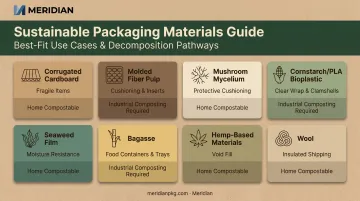
Corrugated Cardboard & Kraft Paper
The most widely recycled packaging material in the U.S., corrugated hits a 96.5% recycling rate, according to EPA data. It needs no special coatings to stay compostable and works as a structural outer box for nearly any shipment.
Most businesses, including Meridian's corrugated box lines, start their sustainability transition here. It's the easiest swap with the least disruption to packing workflows.
Molded Fiber Pulp
Made from recycled paper and cardboard slurry, molded into shape. It absorbs shock well, making it a solid fit for fragile or precision items like electronics or glassware. Meridian's protective cushioning options fall into this same fiber-based category for buyers looking to move off foam.
Mushroom Mycelium Packaging
Agricultural waste bound together by mushroom root systems, grown into foam-like cushioning shapes. It composts in weeks under the right conditions and can match polystyrene for light-duty cushioning strength.
Cornstarch & PLA Bioplastics
Plant-based films and packing peanuts work well for void fill. The catch: these typically need industrial composting facilities to break down properly. Tossed in a home compost bin or curbside recycling, they may not decompose as expected and can even contaminate conventional plastic recycling streams.
Seaweed-Based Films
A fast-renewing material that doesn't compete with farmland, seaweed film offers moisture and grease resistance in a lightweight wrap. It's better suited to smaller items or as an inner layer than as primary structural packaging.
Bagasse (Sugarcane Fiber)
A byproduct of sugarcane processing, bagasse is molded into trays and inserts. It holds up well against heat and moisture, which makes it a practical alternative for products needing more than a basic cardboard tray.
Hemp-Based Materials
Hemp fiber has high tensile strength and, per the European Commission, typically requires little to no pesticide use during cultivation. It shows up in papers, films, and molded packaging shapes.
Wool & Other Agricultural Byproducts
Repurposed wool fiber and similar byproducts offer reusable, biodegradable cushioning. Some vendors note it can be composted with garden waste and breaks down without leaving synthetic microplastic residue.
Sustainable Pallets: The Overlooked Piece of Your Eco-Friendly Shipping Strategy
Most sustainability conversations stop at the box. Pallets are the physical foundation moving nearly every shipped good through a warehouse or supply chain, and they rarely get a second thought.
Eco-friendly pallet options include:
- Reconditioned wood pallets inspected, repaired, and returned to service instead of landfilled
- Recycled hardwood and softwood pallets built from reclaimed material
- Reuse programs that cut virgin lumber demand across repeat shipments
Meridian's Grade A pallets, for example, are recycled hardwood units with minor repairs. The 48×40-inch GMA version supports up to 4,600 lbs at roughly 44–59 lbs. Grade B pallets go further as fully reconditioned units built for general shipping.
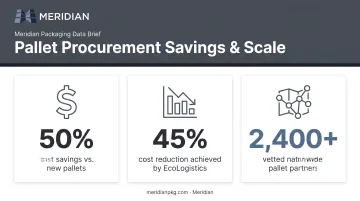
The Recycled Pallets line sources reclaimed hardwood and softwood through 20+ U.S. facilities. Each unit is inspected and repaired before reuse, often at up to 50% cost savings versus new pallets.
EcoLogistics reported a 45% cost reduction using Meridian's recycled pallets while meeting corporate sustainability targets. Sustainable Supply Co. has stayed on the program for two years, citing consistent availability and quality inspection as the deciding factors.
Here's the problem that undermines a lot of well-intentioned sustainability plans: unreliable pallet sourcing. When a supplier falls through last minute, companies get forced into buying whatever's available — usually low-quality, non-recycled pallets that undo months of sustainability progress.
This is where a procurement partner earns its keep. For mid-to-large enterprises managing $500,000 to $10 million or more in annual pallet spend, a vetted nationwide network (Meridian's spans 2,400+ partners) helps lock in recycled and sustainably sourced pallets on a reliable schedule, not a reactive scramble.
That reliability compounds into cost and supply-chain benefits a single-supplier relationship can't match.
End-to-end sustainable shipping only holds if the pallets under your cartons are as intentional as the packaging materials around the product—and if you can source them consistently when volume spikes.
How to Choose the Right Eco-Friendly Packaging for Your Business
Picking a material starts with the shipment itself. Match protection level, end-of-life access, and supplier transparency to what you actually ship.
- Assess product protection needs first. Fragile or precision items need molded fiber or mycelium cushioning. Lightweight, durable goods can often ship in straightforward kraft paper or corrugated cardboard.
- Confirm real-world end-of-life access. A "compostable" mailer is only as good as your customer's ability to dispose of it. Curbside recycling access is far more common than industrial composting access — check before you commit to a material.
- Evaluate cost and supplier transparency at scale. Prioritize vendors who can show certifications and traceable sourcing over those using vague "eco" language without backup.
Getting this wrong in either direction costs money: over-engineering protection wastes material and spend, while under-protecting product drives up damage claims and returns.
Frequently Asked Questions
What is the most environmentally friendly packaging material?
No single material wins universally. Certified compostable options like molded fiber, mushroom mycelium, or FSC-certified paper generally have the lowest overall impact when matched to the right product and disposal infrastructure.
What are some examples of biodegradable packaging materials?
Common options include cardboard, kraft paper, cornstarch/PLA bioplastics, mushroom mycelium, seaweed film, bagasse, and hemp-based materials. Performance depends on protection needs and local disposal access.
What are 20 examples of biodegradable materials?
Twenty common options: cardboard, kraft paper, tissue, molded pulp, hemp, bamboo, banana fiber, cotton, bagasse, jute, sisal, PLA, PHA, cornstarch foam, mycelium, seaweed film, wool, cork, palm leaf, and wood-fiber composites. Choose based on protection needs and how your customers can dispose of the material.
Is cardboard more eco-friendly than plastic packaging?
Generally yes. Cardboard biodegrades and recycles far more easily than plastic, with a 96.5% U.S. recycling rate. That said, its footprint depends on whether it uses virgin or recycled fiber and stays free of plastic coatings or tape.
How can businesses make their entire shipping process more sustainable, not just the box?
Right-size every carton, cut excess void fill, and source recycled or reclaimed pallets and recyclable dunnage. Pair that with order consolidation and efficient routing so the full shipment—not only the box—carries a smaller footprint.
Are wood pallets more sustainable than plastic pallets?
Reconditioned or reclaimed wood pallets are generally more biodegradable and renewable than plastic ones, though plastic pallets can survive more reuse cycles. Reuse programs can make either option more sustainable through extended lifecycle use.