For procurement and logistics managers, though, "most common" doesn't mean "always right." Choosing the wrong box style costs money in damaged freight, wasted cube space, or overspending on protection you don't need. This guide breaks down what RSC boxes actually are, where they excel, how they stack up against alternatives like Full Overlap and die-cut styles, and how to pick the right corrugated packaging for your operation.
Key Takeaways
- RSC boxes lead in shipping for a reason: one-piece construction cuts manufacturing cost and material waste
- Equal-length flaps that meet at the center give a square seal, simpler taping, and consistent closure on the line
- Choose FOL for stacking strength, HSC for open-bin use, and die-cut styles when branding matters most
- The right choice balances product weight, budget, and how fast you need boxes assembled on the line
What is a Regular Slotted Container (RSC) Box?
An RSC is built from a single sheet of corrugated fiberboard, folded into a rectangular sleeve with four flaps on top and four on the bottom. There's no separate lid, no extra pieces, and no glue beyond the manufacturer's joint that seals the sleeve into shape.
The Anatomy of an RSC Box
Every RSC has four flaps of identical length on each end. The two outer (major) flaps are cut to exactly half the box's width, so when you fold them inward, they meet perfectly in the center — no gap, no overlap. The two inner (minor) flaps sit underneath, running the full length of the box.
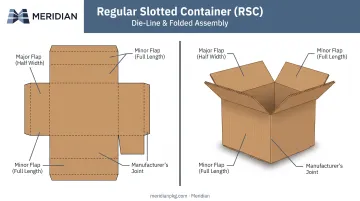
Picture a flattened cardboard cross folding up into a box: that's essentially an RSC.
The European Federation of Corrugated Board Manufacturers assigns the RSC code 0201, placing it in the slotted-box family alongside other one-piece, flap-sealed styles. If you're specifying boxes internationally or working with overseas suppliers, that code is the shorthand everyone recognizes.
Materials and Strength
RSC boxes come in three wall constructions, each suited to different loads:
- Single-wall: One fluted medium glued between two liner sheets. Standard for lighter, uniform products.
- Double-wall: Three liners with two fluted layers between them. Built for heavier or bulkier freight.
- Triple-wall: Four liners, three fluted layers. Reserved for heavy-duty industrial applications.
Two tests determine how much a box can handle:
- Edge Crush Test (ECT): Measures force before the board crushes edge-on; predicts stacking strength in a warehouse or trailer
- Mullen Test: Measures burst resistance—how much pressure the board face can take before puncturing
For pallet stacking or long-haul shipping, ECT is the more useful number to check first.
Meridian's standard RSC line reflects this range: most sizes run on 200# Test Kraft, single-wall ECT-32 board, while the largest option steps up to 275# Test Kraft, double-wall ECT-44 for heavier loads.
Common Terminology
A few terms come up constantly when specifying corrugated boxes:
- Flaps: the four folding panels on the top and bottom of the box
- Scoring: the creased lines that let cardboard fold cleanly without cracking
- Flute: the wavy inner layer that gives corrugated board its rigidity; C-flute is the standard choice for most RSCs
- KDF (Knocked Down Flat): how boxes ship and store before use, folded flat with the manufacturer's joint already sealed
The Business Case for RSCs: Key Supply Chain Benefits
RSCs didn't become the industry default by accident. Their design solves real operational problems.
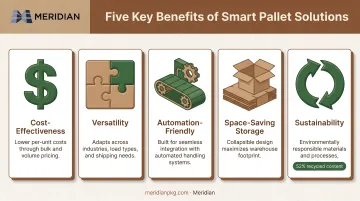
- Cost-effectiveness: No complex tooling, custom dies, or heavy scrap keeps unit cost low. Meridian's standard RSC bundles run $0.88 to $6.58 per box; the 24x24x24-inch double-wall Cube Box is $11.20 in bundles of 10.
- Versatility: One core design covers small parts, machinery components, retail freight, warehousing, 3PL, and e-commerce fulfillment.
- Automation-friendly: The uniform, symmetrical flap layout means RSCs run smoothly through automated case erectors and sealing lines. They're just as fast to fold and tape by hand for lower-volume operations.
- Space-saving storage: Since RSCs ship and store knocked down flat, they take up a fraction of the warehouse footprint that pre-assembled boxes would require.
- Sustainability: Corrugated board typically contains around 52% recycled content, according to the Fibre Box Association, and it's fully recyclable at end of life.
RSC Boxes vs. Other Common Corrugated Styles
RSCs aren't the only option, and knowing when to reach for an alternative matters just as much as understanding the RSC itself.
RSC vs. Half Slotted Container (HSC)
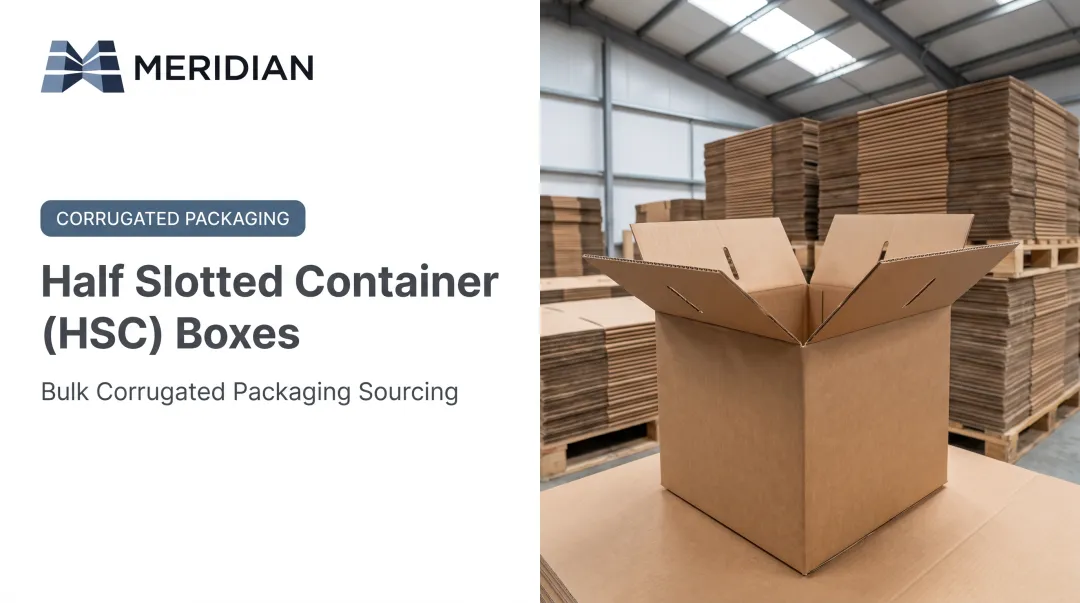
An HSC is essentially an RSC with the top flap set removed entirely, leaving an open-top tray. That makes it a natural fit for retail display bins, produce and bottle trays, and warehouse picking containers where quick visual access matters. Because it uses less material, an HSC typically costs slightly less than a full RSC of the same footprint.
RSC vs. Full Overlap Container (FOL)
Where an RSC's outer flaps meet in the middle, an FOL's outer flaps extend nearly the full width of the box, overlapping almost completely. That extra layer of board on the top and bottom adds real cushioning and stacking strength.
FOLs are the go-to choice for heavy, fragile, or high-value freight that has to survive rough handling. The tradeoff is straightforward: more material means a higher per-unit cost than a comparable RSC.
RSC vs. Die-Cut Boxes
Die-cut boxes are cut and creased with a custom tool, so they can take shapes an RSC simply can't: windows, interlocking tabs, custom inserts, and precise fitted profiles. They're the right pick when packaging is part of the brand experience—think mailer boxes or subscription packaging.
RSCs stay purely utilitarian by comparison. Tooling is the tradeoff: simple dies can run a few hundred dollars, while complex display dies climb into the thousands.
| Style | Best For | Cost vs. RSC |
|---|---|---|
| RSC | General shipping, most industries | Baseline |
| HSC | Display bins, picking trays | Slightly lower |
| FOL | Heavy or fragile freight | Higher |
| Die-cut | Branded unboxing experience | Highest (plus tooling) |
How to Choose the Right Corrugated Box for Your Business
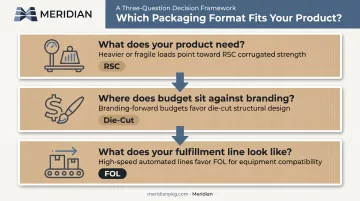
Picking a box style comes down to three practical questions.
1. What does your product actually need? Standard items under roughly 30-40 lbs typically do fine in a single-wall RSC. Heavier or fragile products usually call for double-wall RSC construction or a switch to FOL for added protection.
2. Where does budget sit against branding? If cost efficiency for routine shipping is the goal, RSC wins outright. If the box doubles as a marketing touchpoint, a custom-printed die-cut box may justify the added spend. RSCs can also be custom printed with logos and handling instructions, giving you a budget-friendly branding lift without switching styles.
3. What does your fulfillment line look like? Automated packing lines favor the RSC's predictable, symmetrical fold pattern. If manual assembly speed or warehouse floor space is the bigger constraint, that also tips the scale toward RSC over more complex styles.
Beyond the Box: Optimizing Your Packaging Procurement
Picking the right box style solves half the problem. The other half is making sure you can source it reliably, at a fair price, wherever your operations run.
Companies managing packaging spend across multiple sites tend to hit the same three walls:
- Price volatility — material and freight costs shift constantly; without current market data, teams negotiate reactively instead of timing purchases
- Supply chain disruption — a fragmented U.S. supplier base with uneven service levels makes multi-site sourcing hard to manage
- Inconsistent quality — different suppliers at different sites can mean uneven box performance and more damage claims
This is where a procurement partner earns its keep. Meridian built its network of 2,400+ vetted suppliers to solve this problem, giving clients supplier backups that support a 99% uptime guarantee when a primary source can't fill an order.
That collective network also brings volume-driven pricing to corrugated box buyers who might not hit high-volume thresholds on their own. It has helped deliver an average 16% savings for Meridian's national clients.
On top of sourcing, Meridian's Procurement Insights Dashboard tracks spend by SKU, supplier, and location. Quarterly market reviews flag when it's time to renegotiate or return to market.
For teams juggling boxes, pallets, and everything in between, that visibility turns packaging from a reactive cost center into a category you can plan around.
Frequently Asked Questions
What does RSC mean in corrugated boxes?
RSC stands for Regular Slotted Container, the most common style of shipping box. It's built from a single piece of corrugated board with four flaps of equal length that meet in the center when closed.
What is the difference between RSC and HSC boxes?
An HSC (Half Slotted Container) is identical to an RSC except it's missing one set of flaps. That open top makes it ideal for use as a bin, tray, or picking container.
Are RSC boxes suitable for heavy products?
Standard single-wall RSCs work well for most shipments. Products over roughly 40 lbs are better protected in a double-wall RSC or a Full Overlap (FOL) box for superior stacking strength.
Can RSC boxes be custom printed for branding?
Yes. RSCs can be custom printed with logos, handling instructions, and other branding elements—a cost-effective way to build brand visibility without a more expensive box style.
What is the most cost-effective type of shipping box?
The Regular Slotted Container is generally the most cost-effective option. Its simple, one-piece design minimizes material waste and manufacturing complexity compared with other corrugated styles.
How do you measure an RSC box correctly?
RSC boxes are measured using internal dimensions in the order of Length x Width x Depth. Getting this order right ensures the box fits your product and matches supplier specifications.