Introduction
Walk through any warehouse and you'll see it everywhere: thin bands cinched tight around pallets, boxes, and bundles of lumber. Strapping does its job so quietly that most businesses never think about it until something goes wrong.
And when it goes wrong, it's expensive. Around 66% of cargo-damage incidents trace back to poor practices in the overall cargo-packing process, according to TT Club's claims analysis.
Choosing the wrong strap material, or the wrong supplier, often means load shifting, damaged product, and costly in-transit claims.
This guide covers what strapping actually is, the main material types, where it's used, the equipment behind it, and how to pick the right solution for your shipping operation.
Key Takeaways
- Match strap material to load weight, rigidity, and environment for secure transit
- Steel delivers max tensile strength; PET and PP handle most pallet loads at lower cost
- Edge protectors and proper joins stop failure at a unit load’s weakest points
- Sustainability pressure is pushing more buyers toward paper and corded/woven alternatives
- Buyers spending $500,000–$10M+ yearly gain more from a dedicated procurement partner than piecemeal sourcing
What Is Strapping?
Strapping, sometimes called bundling or banding, is a flat, flexible material wrapped around items to combine, reinforce, or fasten them together. In packaging and shipping, it is a basic control for load security.
Why Strapping Matters Operationally
Strapping prevents load shifting during handling and transit. That gap is often the difference between a pallet arriving intact and one arriving as a damage claim. Roughly two-thirds of cargo damage is tied to packing practices, so strap selection is a direct risk-management decision.
Industry standards govern strapping practices for palletized freight. The most cited is ASTM D3953, which sets breaking strength, elongation, and seal-joint performance for flat steel strap and seals used in loading, lashing, and bracing.
The E-Commerce Factor
Freight volumes keep climbing. Seasonally adjusted US retail e-commerce sales hit $326.7 billion in Q1 2026, up 9.8% year over year, according to the US Census Bureau. More parcels and pallets in the supply chain means more chances for a weak strap job to fail between the warehouse and the customer dock.
Types of Strapping Materials
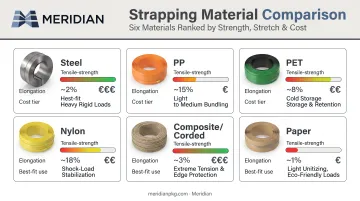
Strap material selection comes down to four variables: load weight, rigidity, environmental exposure, and budget. Here's how the main options stack up.
Quick comparison:
- Steel — highest tensile strength; heavy, rigid loads
- PP — lowest cost; light-to-medium bundling and palletizing
- PET — steel alternative with strong tension retention
- Nylon — premium creep resistance for cold storage
- Composite / corded — abrasion-resistant; often re-tensionable
- Paper — recyclable option for paper-product bundling
Steel Strapping
Steel delivers the highest tensile strength of any common strapping material. It's the go-to for metal coils, bricks, pavers, and other heavy, rigid loads.
Manufacturers like Signode differentiate cold-rolled grades for lighter steel applications from heat-treated grades built for the most demanding loads. Steel strap is typically sold by weight (coils, not linear footage) because precise length varies with gauge and manufacturing tolerances.
Polypropylene (PP) Strapping
PP is the budget-friendly workhorse for light-to-medium bundling and general palletizing. Standard PP tensioned to 20-40% of break strength elongates roughly 4-10%, so it can lose tension as loads settle.
It's also vulnerable to UV degradation outdoors, with an unprotected service life of roughly 30-90 days depending on sun exposure and strap color (black holds up best). UV-stabilized versions exist for outdoor storage.
Meridian's PP coils run 0.5 in × 7,200 ft at $68 per coil and 0.625 in × 6,000 ft at $85 per coil, both available with a one-coil minimum order.
Polyester (PET) Strapping
Polyester is the practical steel alternative. It retains tension far better than PP, elongating only 2-6% under standard tensioning, and it holds up well on rigid, heavy, or expanding loads like lumber packs and palletized metal. For loads that settle or shift slightly during long-haul transit, that retained tension matters.
Meridian stocks PET strap at 0.5 in × 7,200 ft for $125 per coil — a middle-ground option between PP's economy and steel's raw strength.
Nylon Strapping
Nylon offers the greatest specific strength-to-weight ratio of any strapping material, but it's seen limited modern use because of cost. Where it still shows up is cold-storage applications, where its resistance to creep (gradual loosening under sustained load) makes it worth the premium.
Composite and Corded/Woven Strapping
Composite strapping combines polyester fibers with a plastic coating, creating an abrasion-resistant alternative sometimes marketed as "synthetic steel." Corded or woven polyester strap, joined with a galvanized-steel buckle, can typically be re-tensioned after application — a genuine safety advantage over steel for workers handling straps by hand.
Paper Strapping
Paper strap is the eco-conscious option, commonly used to bundle paper products between industrial processes without cutting the strap between bundles. Products like Signode's LEVEX are fully recyclable within standard paper-waste streams.
Match the material to your load weight, rigidity, outdoor exposure, and budget—those four variables matter more than brand labels when you specify strap.
Common Uses & Applications of Strapping
Strapping shows up across nearly every stage of the supply chain:
- Bundling lumber, pipe, tubing, wire coils, newspapers, and mail
- Securing palletized and unpalletized loads for handling and transportation
- Closing corrugated boxes, cartons, and glued flat-box bundles
- Bracing shipments during rail loading, truck loading, and general cargo lashing
The Role of Edge Protectors
Corners are where straps do the most damage — to themselves and to the product underneath. Edge protectors distribute tension evenly across the corner, preventing crushing, scratching, and the strap cutting into the load itself. On lumber packs especially, moisture-resistant edge protection under the strap at sensitive corners is standard practice.
Those applications show up daily in the sectors that move freight. E-commerce fulfillment, warehousing, manufacturing, and 3PL operations all rely on strapping to keep loads intact from dock to destination.
Strapping Equipment & Joining Methods
The right strap is only half the equation. Equipment and joining method determine whether that strap actually holds.
Hand Tools
For low-volume applications, manual tools do the job: tension, seal, cut, done. Meridian's Manual Strapping Tool (Combo) handles 1/2"–5/8" strap widths and runs $195 per unit, a straightforward option for shipping and warehousing teams packing a handful of loads per shift.
Higher-volume operations need more speed and less operator fatigue. Battery- or air-powered tools automate tensioning and sealing. Meridian's Battery Strapping Tool, built with a lithium-ion battery and steel housing, also covers 1/2"–5/8" strap and lists at $1,895. It's built for medium-to-high-volume operations where manual tools become a bottleneck.
Strapping Machines
Semi-automatic machines let an operator position the package and loop the strap manually. The machine then handles tensioning, sealing, and cutting.
Fully automatic systems go further. Arch designs integrated with conveyors and package-position sensors apply strap with no operator intervention, the standard for high-throughput warehousing and manufacturing lines.
Meridian's Automatic Strapping Machine, a pallet-size unit priced at $5,995, fits this fully automatic category for facilities running high-volume fulfillment or production.
Joining Methods
Joining methods fall into three categories:
- Heat seal: A heated tongue melts overlapping strap ends, which are then pressed together
- Friction weld: Strap ends are rubbed together fast enough to melt and fuse on contact (common for PP and PET)
- Seal/buckle joints: A metal or plastic seal is crimped, or a buckle is used, to lock the strap without heat
The joint is often the first point of failure when the wrong method is paired with the wrong strap. Matching joining technique to material matters as much as the strap itself.
How to Choose the Right Strapping Solution for Your Business
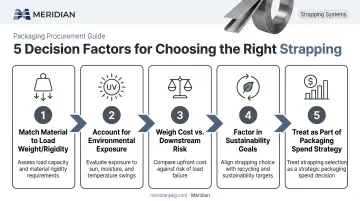
Picking a strap isn't guesswork if you work through it systematically:
Match material to load weight and rigidity. Steel or PET for heavy, rigid loads (metal coils, brick, lumber). PP for lighter bundling where cost matters more than long-term tension retention.
Account for environmental exposure. Outdoor storage or long-distance transit calls for UV-resistant strap. Standard PP degrades in as little as 30 days under direct sun; UV-stabilized PP or PET holds up considerably longer.
Weigh upfront cost against downstream risk. A cheaper strap that fails in transit costs far more in damaged product, returned shipments, and claims than the few cents saved per coil.
Factor in sustainability goals. Paper strapping and corded/woven alternatives give buyers facing packaging-waste pressure a genuine eco-conscious option without sacrificing performance on the right applications.
Treat strapping as part of a broader packaging spend strategy. Strapping is rarely bought alone; it's one line in a larger pallet and packaging budget. Companies spending $500,000 to $10M+ annually on these materials often leave money on the table by sourcing strap, pallets, and cushioning from separate vendors.
This is where a dedicated procurement partner like Meridian Packaging helps. Meridian runs a free spend analysis to baseline your packaging categories, then taps a network of 2,400+ trusted partners nationwide for more competitive quotes and steadier supply.
For strapping, that means steel, PET, and PP coils with one-coil minimums, volume pricing on recurring orders, and equipment from $195 manual tools to $5,995 automatic machines, all through one relationship instead of five.
Frequently Asked Questions
What is strapping in medical terms?
In a medical context, strapping refers to adhesive tape or firm bandaging used to support an injured or inflamed body part. It's unrelated to the packaging strapping covered in this guide, which refers specifically to bundling and load-securing material.
What is the strongest type of strapping material?
Steel has traditionally offered the highest tensile strength, making it the standard for the heaviest, most rigid loads. Tensilized polyester and nylon are strong plastic alternatives used where steel's weight, cost, or handling risk make it impractical.
Is polypropylene or polyester strapping better for pallets?
Polyester (PET) retains tension significantly better on rigid, heavy, or settling pallet loads. Polypropylene works well for lighter, less rigid bundling where cost is the priority over long-term tension retention.
How do you join strapping without a machine?
Manual sealers, hand-operated crimping tools, and buckle joints all let you join strap without automated equipment. Buckle joints are especially common with corded or composite strap and don't require any tool at all.
Is strapping recyclable or eco-friendly?
Paper strapping is the most eco-friendly option, fully recyclable in standard paper-waste streams. Steel and many plastic strap types (PET, PP) are also recyclable, though acceptance depends on your local recycling facility's capabilities.
What's the difference between strapping and stretch wrap?
Strapping uses tensioned bands to tie down heavy or rigid loads and restrain expanding units during rough handling. Stretch wrap uses flexible film to contain lighter or irregular stacks and add a moisture barrier — some loads use both together for maximum stability.