But not all crates are built the same way, and the material you choose changes everything. It affects how well the item survives transit, how much you pay in freight, whether your shipment clears customs without a hitch, and whether the crate can be used again.
This guide breaks down the main crating materials on the market, how they stack up against each other, and how to pick the right one for your next shipment.
Key Takeaways
- Crating material choice drives protection level, freight cost, and customs compliance simultaneously
- Solid wood, metal, plastic, and corrugated cardboard each serve distinct weight, budget, and durability needs
- International shipments generally require ISPM-15 heat-treated wood or a compliant alternative
- Matching material to shipment frequency and environment prevents overspending and damage claims
What Is Crating and Why Material Selection Matters
What Is Crating?
Crating means building a rigid, custom enclosure, usually from wood, metal, or plastic, around an item to protect it during shipping, handling, or storage. Unlike a standard cardboard box, a crate is engineered to the specific dimensions and weight of what's inside it.
Industries lean on crating constantly:
- Manufacturing for machinery and production equipment
- Aerospace for lightweight airframe components and ground-support gear
- Automotive for engines, batteries, and drivetrain parts
- Fine art for sculptures and framed pieces
- Industrial equipment shippers moving items too heavy or irregular for pallets alone
Crate design is an engineering decision driven by the cargo's weight, fragility, and the conditions it will face in transit.
Why Material Selection Matters
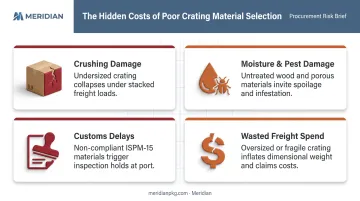
The material you build a crate from determines four things at once: protection level, freight weight (and therefore cost), customs compliance, and reusability.
Get it wrong, and the consequences show up fast:
- Crushing damage from under-built crates that can't handle stacking or rough handling
- Moisture and pest damage from untreated wood exposed to humidity or long transit times
- Customs delays when wood isn't properly heat-treated—noncompliant US-bound shipments can be denied entry
- Wasted freight spend from an overbuilt crate that adds unnecessary weight
For enterprises shipping at real volume, crate and pallet materials are their own procurement category—not a side buy. Meridian Packaging helps mid-to-large enterprises manage that indirect wood-based packaging spend through a nationwide network of 2,400+ vetted partners.
Types of Crating Materials
Crating material isn't one-size-fits-all. The right choice depends on the item's weight, fragility, value, and the journey it needs to survive. Each material differs in strength, weight, cost, environmental resistance, and reusability—so the best fit varies by industry and shipping profile.
Solid Wood Crates
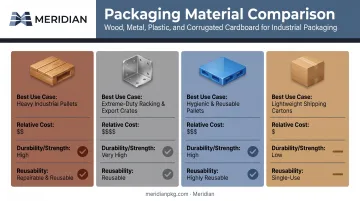
Solid wood crates are built from sawn lumber, often pine, framed into a rigid box. They remain the most traditional and widely used crating material in industrial shipping, largely because the raw material is affordable and easy to work with on-site.
Best suited for:
- Heavy, oversized, or irregularly shaped equipment
- International shipments requiring ISPM-15 heat-treated certification
Strengths:
- Strong load-bearing capacity for heavy machinery
- Repairable in the field without specialized tools
- Low material cost relative to metal or plastic
Limitations:
- Heavier and bulkier than plastic alternatives
- Vulnerable to moisture and pests if left untreated
That split shows up in typical market pricing Meridian sources for buyers. A standard export crate in kiln-dried pine often starts around $185 per unit, while a heavy-duty custom crate in heat-treated hardwood with full ISPM-15 documentation often starts near $420 per unit. Heat-treated 2"x4"x8' lumber for blocking and bracing runs about $7.40 per unit.
Metal Crates (Steel/Aluminum)
Metal crates and platforms are built from steel or aluminum framing. They are used most often for extremely heavy or high-value industrial cargo that needs to survive multiple trips.
Best suited for:
- Heavy-duty, repeated-use applications like mining, aerospace, or construction equipment
- Shipments that move frequently between the same two points
Strengths:
- Superior durability under rough handling
- High load capacity
- Strong resistance to moisture and pests
Limitations:
- Significantly higher upfront cost than wood
- Longer lead times for custom fabrication
To put a number on it, ASTM D6255 covers new, reusable steel or aluminum slotted-angle crates rated for lightweight airframe components and bulky items up to 3,000 pounds. Heavier welded steel enclosures used in mining or construction go well beyond that spec.
Plastic Crates (HDPE/Injection-Molded)
Plastic crates and cases are molded or panel-built, most commonly from high-density polyethylene. They give shippers a lightweight, weatherproof alternative to wood without sacrificing much structural integrity.
Best suited for:
- Smaller, high-value, or sensitive equipment such as electronics or medical devices
- Applications requiring repeated reuse and weather resistance
Strengths:
- Lightweight construction that lowers freight cost
- Watertight and corrosion-proof by design
- Built for many reuse cycles in closed-loop shipping
Limitations:
- Higher unit cost for large custom sizes
- Limited capacity for very heavy loads compared to wood or metal
Corrugated Cardboard Crates
Corrugated crating uses heavy-duty, multi-layer cardboard construction, often paired with a wood skid base, for lighter industrial products that don't need the rigidity of a full wood or metal enclosure.
Best suited for:
- Lightweight-to-medium products
- Retail and consumer goods
- Single-use or short-distance shipments
Strengths:
- Lowest cost of any crating material
- Lightweight and recyclable
Limitations:
- Limited protection against crushing or moisture
- Generally treated as single-use
Not all corrugated performs the same. Manufacturer Tri-Wall reports that its triple-wall corrugated fiberboard has 10 times the compression strength of conventional corrugated board. In some cases it outperforms similarly sized wood packaging while staying lighter for air freight.
How to Choose the Right Crating Material
The right material depends on the item's characteristics and its shipping journey, not on which material your team happens to be most familiar with.
Match the crate to these factors:
- Item weight, fragility, and value: Heavier or higher-value items typically need wood or metal. Lighter goods may only need corrugated or plastic.
- Shipping distance and mode: Ocean or air freight often requires ISPM-15 compliant wood—or a non-wood alternative—to avoid customs holds.
- Reusability needs: One-way shipments favor lower-cost wood or corrugated. Recurring lanes favor metal or plastic for a lower cost per trip.
- Environmental exposure: Outdoor storage or long transit calls for moisture- and pest-resistant options such as treated wood, metal, or plastic.
- Budget, scale, and sustainability: At volume, crating is a recurring line item. High-volume shippers often use procurement partners to source sustainable wood-based materials and run competitive RFQs.
Meridian's Packaging Optimization Audit documents on-site usage, flags redesign opportunities, and manages nationwide RFQs, with a guaranteed 5-25% spend reduction within 90 days. A 2,400+ partner network gives enterprises leverage they will not get buying crating materials one supplier at a time.
Common Mistakes to Avoid When Selecting Crating Materials
Even experienced shipping teams fall into a few predictable traps when selecting crating materials.
- Overbuilding. Choosing metal or heavy-duty wood when a lighter material would fully protect the item adds unnecessary freight weight and cost.
- Ignoring compliance requirements. Shipping internationally with non-heat-treated wood risks customs rejection. Canada, Australia, and the UK can order noncompliant wood packaging removed, treated, or destroyed—at the importer’s expense.
- Underestimating long-term costs. Choosing the cheapest one-way material for monthly shipments often costs more than reusable metal or plastic over time.
- Overlooking environmental exposure. A crate that can't handle humidity, temperature swings, or outdoor storage invites damage claims no matter how sturdy it looked on paper.
Conclusion
Crating material selection directly shapes protection, customs compliance, and total shipping cost for every item that leaves your dock.
Wood, metal, plastic, and corrugated each solve different problems:
- Wood — heavy, irregular loads at a reasonable cost
- Metal — repeated rough use and returnable programs
- Plastic — moisture-sensitive gear and clean environments
- Corrugated — lightweight shipments when budget matters most
No single material fits every shipment. Treating them as interchangeable is where most costly mistakes start.
Match the material to the load, route, and reuse cycle. When volume justifies it, a packaging procurement partner helps those choices hold up on the loading dock and on the balance sheet.
Frequently Asked Questions
What material are crates made of?
Most crates are built from wood, either solid lumber or plywood, since it balances strength, cost, and repairability. Metal, plastic, and corrugated cardboard are also common depending on load weight and durability needs.
What are the different types of crates?
The four main types are solid wood, metal (steel or aluminum), plastic (typically HDPE), and corrugated cardboard. Wood and metal suit heavy or repeat-use shipments, while plastic and corrugated fit lighter or single-use needs.
What is the difference between packing and crating?
Packing involves wrapping or cushioning an item, using materials like foam, bubble wrap, or void fill. Crating means building a rigid enclosure around the item for structural protection during handling and transit.
Which crating material is most cost-effective for heavy machinery?
Solid wood is typically the most cost-effective option upfront for heavy machinery. Reusable metal crates can save money over multiple shipments, since the higher initial cost gets spread across many trips.
Do wooden crates need to be heat-treated for international shipping?
Yes. Most countries, including the US, Canada, Australia, and EU members, require solid wood packaging to meet ISPM-15 heat-treatment standards and carry an official stamp before it can clear customs.
Can crating materials be reused or recycled?
Wood and metal crates can often be repaired and reused across multiple shipments if properly maintained. Corrugated materials are generally single-use but recyclable, with US cardboard recycling rates commonly cited between 71-76%.