Introduction
Stretch wrap looks simple until the wrong roll shows up on a busy dock. Gauge, the film's thickness rating, is the single property that decides whether a pallet holds together through three transfers or splits open on the truck.
Many buyers pick gauge by habit or price tag alone. That's a costly guess.
Film that's too thin lets loads shift, corners puncture, and products arrive damaged. Film that's too thick just burns through budget and slows down your wrap crew.
This guide breaks down the gauge ranges that matter, a load-capacity reference chart, the technical properties working alongside gauge, and the most common mistakes that lead to either damaged freight or wasted spend.
Key Takeaways
- Gauge measures film thickness - 100 gauge equals 1 mil; higher gauge means thicker, stronger film
- 80 gauge is the standard workhorse, handling most uniform pallet loads up to roughly 2,400 lbs
- Cast vs. blown film, true vs. equivalent gauge, and load shape all change real-world performance
- Under-gauging risks film failure; over-gauging wastes material and labor
- Match gauge to weight, shape, and application method to control both protection and cost
What Stretch Wrap Gauge Represents in Film Performance
Gauge is a thickness designation, not a strength grade by itself. The math is straightforward:
- 1 gauge = 0.01 mil
- 1 mil = 25.4 microns
- 80 gauge = 0.8 mil ≈ 20.3 microns
Buyers order gauge as a spec. Gauge also drives performance: tensile strength, puncture resistance, and how much force a wrap can hold before tearing. That's why two rolls with the same gauge number don't always perform the same on the dock.
True-Gauge, Equivalent, and Pre-Stretched Films
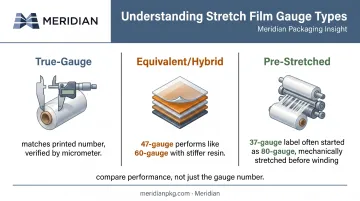
True-gauge film measures exactly what it claims, verified with a micrometer. Equivalent or hybrid film uses a modified resin blend to achieve similar retention force at a lower measured thickness. Robopac notes that 47-gauge hybrid film is engineered with a stiffer resin to perform roughly like standard 60-gauge film for loads up to about 1,800 lbs.
Pre-stretched film adds another wrinkle. A roll labeled 37 gauge, for example, often starts as 80-gauge film that the manufacturer mechanically stretches before winding. The printed number is lower than the film's performance-equivalent gauge, which is why comparing rolls on gauge number alone can mislead buyers used to true-gauge products.
Factors That Influence Gauge Performance in Real-World Operation
A gauge rating from a spec sheet and what happens on your dock floor are two different things. Several variables shift that gap:
- Manufacturing tolerances: Resin quality and extrusion consistency create thickness variance within a single roll
- Load profile: Uniform boxed loads need less puncture resistance than irregular loads with sharp edges or metal parts
- Temperature and environment: Cold storage below 35°F changes film properties; outdoor UV degrades unprotected film
- Application method: Hand tension varies more than machine tension, so the same gauge stretches differently
Meridian's catalog reflects this split directly: 60-gauge and 80-gauge hand film for manual wrapping, alongside a 63-gauge machine stretch roll built for the higher, more consistent tension that automated equipment applies.
Stretch Wrap Gauge Range: Thickness Chart & Load Capacity
Gauge selection comes down to three inputs:
- Load weight
- Film format (hand vs. machine vs. banding)
- How much safety margin you want built in
The numbers below are industry selection guides, not universal engineering ratings. Treat them as a starting point rather than a guarantee.
Nominal Gauge-to-Load Capacity Chart
| Gauge | Typical Load Capacity | Common Application |
|---|---|---|
| 37 | Under 800 lbs | Pre-stretched; light hand or banding use |
| 47 | Up to 1,800 lbs | Hybrid film; hand or machine |
| 60 | Approx. 1,800 lbs | Hand or machine, general use |
| 63 | Up to 2,200 lbs | Hand or machine, minimal sharp edges |
| 70 | Approx. 2,200-2,400 lbs | Hand or machine |
| 80 | Approx. 2,200-2,400 lbs | Hand or machine, industry standard |
| 90 | Approx. 2,400-2,600 lbs | Hand or machine, heavier loads |
| 100 | Approx. 2,800-3,000 lbs | Machine preferred for heavy loads |
| 115 | 3,000 lbs or more | Hand or machine, dense freight |
| 150+ | No standard published limit | Machine or banding, extreme loads |
Conversion reference: gauge ÷ 100 = mil; mil × 25.4 = micron. So 63 gauge = 0.63 mil = about 16 microns.
Those chart values are nominal, though—and nominal thickness is only half the decision.
Thickness Tolerance and Safe Operating Margin
Published gauge values are nominal averages, not fixed guarantees. Actual thickness can vary slightly across a single roll due to resin and extrusion conditions. Wrapping a load exactly at a gauge's rated capacity leaves no room for error.
Build in a margin for:
- Shifting loads during transit or braking
- Temperature swings between warehouse and truck
- Occasional drops or rough handling at transfer points
Running loads at the top of a gauge's rated capacity raises breakage risk and wears out usable wraps faster. A little headroom costs far less than a damage claim.
Key Technical Properties That Define Stretch Wrap Gauge Performance
Gauge sets the baseline, but three other properties determine whether a wrap actually holds.
Stretch Percentage and Load Retention
Pre-stretch capacity (how far film elongates during application) directly affects bundling tightness. A thinner true-gauge film with higher pre-stretch can sometimes retain loads better than thicker film. Retention force depends on both thickness and how tightly the film is applied.
Puncture and Tear Resistance
Gauge correlates with resistance to sharp corners and protruding edges, but not in a straight line. Irregular loads such as metal brackets, crated equipment, or stacked lumber typically need one to two gauge tiers higher than a uniform load of the same weight, regardless of what the weight chart suggests.
Cling and Layer Adhesion
Film-to-film cling keeps wraps from loosening in transit. This is a separate property from thickness and doesn't scale linearly with gauge. A thick film with poor cling can unwind faster than a thinner film engineered for aggressive tack.
Trade-Offs Between Gauge, Cost, and Waste
Bumping up gauge raises material cost per roll. But it can also reduce total wraps needed per load and cut labor time, which changes the real math.
- Higher gauge = higher roll price, potentially fewer rolls consumed per month
- Lower gauge = cheaper roll, but possibly more wraps and more frequent roll changes
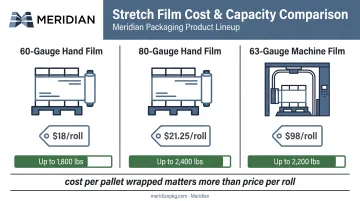
- Cost per pallet wrapped is the number that matters, not price per roll
Meridian's stretch film lineup illustrates the range buyers weigh against this trade-off: 60-gauge hand film at $72 per case ($18/roll), 80-gauge hand film at $85 per case ($21.25/roll), and a 63-gauge machine roll at $98 per roll. Comparing these side by side against actual load requirements, rather than defaulting to the priciest option, is how total spend stays under control.
How to Choose, Measure, and Avoid Common Gauge Mistakes
Specifying and Verifying Gauge
Confirm gauge on the product datasheet, and check whether the number is true gauge or equivalent gauge. A micrometer is the only reliable way to verify actual thickness once film arrives.
Rated (nominal) gauge on the packaging and field-tested actual gauge can differ. Gaps show up more often with lower-cost equivalent films than with true-gauge products.
Risks of Choosing the Wrong Gauge
Getting gauge wrong cuts both ways:
- Under-specifying for the load weight leads to mid-transit film breakage, load shifting, and damage claims
- Over-specifying raises material cost and application fatigue without real gain on light or uniform loads
Common Misinterpretations to Avoid
- Treating nominal gauge as an absolute guarantee instead of an average measurement across the roll
- Assuming true-gauge and equivalent-gauge films with the same rated number perform identically
- Applying one gauge across every load type instead of adjusting for shape, weight, and handling method
For businesses shipping palletized freight at scale, gauge choices rarely stand alone. Film selection works best when it lines up with the rest of your pallet and load-securing spend. Meridian helps clients coordinate stretch wrap with broader packaging procurement so those decisions get optimized together.
Conclusion
Gauge drives load capacity, puncture resistance, and cost efficiency at the same time. Treat it as a performance choice, not a checkbox on the spec sheet.
Knowing gauge ranges, tolerances, and the trade-offs among cast, blown, true-gauge, and equivalent films helps you avoid under-protection and overspending.
Match final gauge to load shape, application method, and environmental conditions—use the standard weight chart as a starting point, not the only input.
Frequently Asked Questions
Which is stronger, 60 or 80 gauge plastic wrap?
80 gauge is thicker and generally handles more weight, up to roughly 2,400 lbs versus about 1,800 lbs for 60 gauge. Some 60-gauge films made with different resin blends can still match 80-gauge performance.
How thick is an 80 gauge wrap?
80 gauge equals 0.8 mil, or roughly 20 microns. The conversion is simple: divide gauge by 100 to get mil, then multiply by 25.4 for microns.
What is the difference between gauge and mil?
Gauge is 1/100 of a mil (gauge ÷ 100 = mil). Gauge is the more commonly used unit in the stretch film industry because it allows finer distinctions without decimals.
What gauge stretch wrap is best for general pallet use?
80 gauge is the industry-standard, all-purpose thickness for most uniform pallet loads. It balances puncture resistance and load capacity without overspending on material.
Is a higher gauge always better for load protection?
Not necessarily. Beyond a certain point, extra gauge adds cost and can increase worker fatigue during hand-wrapping without meaningfully improving protection on lighter or uniform loads.
What's the difference between hand-grade and machine-grade gauge selection?
Machine wrappers apply steady high tension and pre-stretch, so you can often run a lighter gauge than hand-wrapping needs for the same load. Hand-grade film is usually thicker because manual stretch can't match machine levels.