This is the core problem with flat, lay-flat poly bags: they lack depth. They work fine for thin, flat items, but bulky or heavy products need a bag that can expand without losing structural integrity. That's where poly gusset bags come in.
This guide covers what a poly gusset bag actually is, the difference between side and bottom gusset styles, the benefits they bring to packing operations, where they show up across industries, and how to choose the right one for your business.
Key Takeaways
- Gusseted poly bags expand fill capacity with side or base folds while keeping the same flat-packed footprint.
- Side gussets fit elongated products on automated lines; bottom gussets stand upright for retail display.
- LDPE, LLDPE, and HDPE cover most uses, including food-contact grades for direct food packaging.
- Match bag choice to product dimensions, film thickness, fill method, and material grade.
What Is a Poly Gusset Bag?
A gusset is an added fold or panel of material that expands a structure's capacity. The term traces back to a piece of flexible armor that covered joints like the elbow or knee, allowing movement without sacrificing protection. Packaging borrowed the same principle: a fold of extra film that lets a bag flex and expand where a flat surface would tear or restrict.
A poly gusset bag has extra polyethylene material folded into the sides or bottom, expanding to hold bulkier contents than a standard flat bag can accommodate. When empty, the gusset tucks flat, keeping the bag's footprint compact for storage and shipping. Once filled, that folded film unfolds outward, adding real depth and volume.
Compare that to a standard lay-flat poly bag. A flat bag is just two layers of film sealed at the edges. It has no built-in depth, so anything with real dimension stretches the seams or forces an awkward, lopsided fit. A gusseted bag solves that by design.
How Poly Gusset Bags Are Made
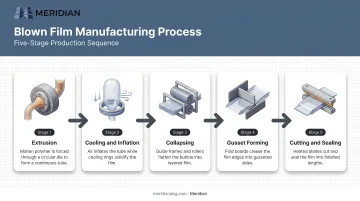
Manufacturing gusset bags is a specialized, high-speed process:
- Extrusion – Liquid polymer is pushed through a circular die, forming an inflated tube of film.
- Cooling and inflation – Air inflates the tube while it cools and solidifies into a continuous bubble.
- Collapsing – Guide frames flatten the tube evenly as it moves down the line.
- Gusset forming – A gusset board folds pleats into the film's edges as it's collapsed, creating the tucked fold that later expands.
- Cutting and sealing – The film is cut to length and sealed into finished bags.
Common Resin Types
Most poly gusset bags are made from one of three resins:
- LDPE (low-density polyethylene) – Flexible and widely used for general-purpose gusseted bags.
- LLDPE (linear low-density polyethylene) – Adds puncture resistance, useful for heavier or sharper goods.
- HDPE (high-density polyethylene) – Offers more rigidity and strength for demanding applications.
Food-contact-compliant film is also available. Resins used in direct food-contact packaging must meet the FDA's requirements under 21 CFR 177.1520, which set purity and use limits for olefin polymers.
Gusset placement changes performance as well. Folds can run along the sides or sit at the base, and each position affects how the bag expands, stands, and packs—side versus bottom gussets are the next distinction to weigh.
Side Gusset vs. Bottom Gusset Poly Bags
Side Gusset Poly Bags
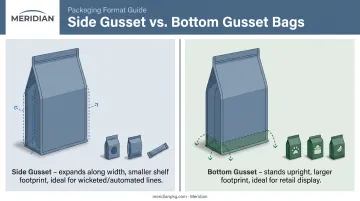
Side gusset bags fold in on the left and right edges rather than at the bottom. This makes them a natural fit for elongated, bulky, or oddly shaped products, since the bag can expand along its width without changing its overall length.
Most side gusset bags run with a single seal along the length and base, a configuration that suits high-speed, wicketed, automated packing lines. Wicketed bags hang from a metal bar through holes punched in the bag's lip, letting equipment feed and fill them continuously without manual handling.
Common uses include:
- Bread and bakery items
- Fresh produce
- Frozen foods
- Hardware, fasteners, and parts packaging
- Box and trash liners
Bottom Gusset Poly Bags
Bottom gusset bags fold only at the base. That fold lets the bag stand upright on its own, which matters when shelf presence or product display is part of the packaging job.
Three sub-styles are common:
- Plow bottom — one-piece construction with no visible gusset seal
- K-seal — folds rising at roughly a 30-degree angle
- Round bottom — edge-welded style, also called Doyen
Typical uses include:
- Coffee
- Pet food
- Confectionery
- Retail and display packaging
| Feature | Side Gusset | Bottom Gusset |
|---|---|---|
| Fold location | Left and right edges | Base only |
| Stands upright | No | Yes |
| Best for | Elongated, bulky, or odd shapes | Retail display and shelf presence |
| Shelf footprint | Smaller at same volume | Larger / bulkier at same volume |
| Line fit | Strong on wicketed, high-speed lines | Common for stand-up retail packs |
Bottom gusset bags are generally larger than side gusset bags holding the same volume. According to Eagle Flexible Packaging, side-gusset packages use less shelf space, while bottom-gusset packages are bulkier at equivalent volume.
If storage or shelf space is tight, weigh that footprint against the upright-standing benefit before you choose.
Key Benefits of Poly Gusset Bags
The gusset does more than add shape. It changes how a bag performs across the entire packing and shipping process.
- Unfolds to hold bulkier or heavier items without upsizing the flat-packed bag
- Adds load-bearing strength at the seams and base, cutting blowout risk under weight
- Ships and stores flat, then expands only when filled—so you don't pay for air
- Runs on hand-loading, semi-automatic, and fully automatic packing lines for high-volume ops
For businesses scaling up, this matters at the SKU level too. Meridian's gusseted bag line, for example, includes an expandable 12 x 10 x 24-inch option built specifically for bulkier or irregularly shaped items, giving buyers a stock option without needing a custom run for every use case.
Common Industry Applications
Poly gusset bags serve sectors with different capacity, durability, and compliance needs.
- Food and beverage: Bread, fresh produce, frozen foods, and bulk ingredients rely on gusseted formats. Bags that touch food need film that meets FDA food-contact rules, not generic polyethylene stock.
- Industrial and hardware: Parts, fasteners, and electronics packaging gain from the extra capacity a gusset provides, especially with sharp edges or uneven shapes.
- Retail and specialty packaging: Promotional bags, gift packaging, and personal care items use gusseted formats for function and shelf appeal.
- Waste and logistics: Gusseted trash liners maximize fill capacity per bag. Meridian stocks a 55-gallon, 2-mil trash liner built for heavier-duty use.
How to Choose the Right Poly Gusset Bag for Your Business
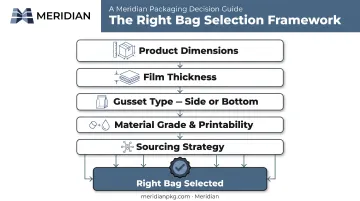
Picking the right gusset bag comes down to five practical questions.
1. What are your product dimensions? Measure product width, height, and depth, then match those against the bag's flat width, gusset depth, and overall length. Underestimating depth is the most common sizing mistake.
2. What film thickness do you need? Thicker film handles heavier products, sharp edges, and rougher handling. Lighter film works fine for hand-loaded, low-impact applications. A 2-mil thickness is a common standard starting point, with heavier gauges available for demanding loads.
3. Side gusset or bottom gusset? Base this on your packing method and end use:
- Side gusset: manual fill, elongated products, or automated/wicketed lines
- Bottom gusset: bags that need to stand upright for display
4. What material grade and printability do you need? Food-grade, FDA-compliant LDPE is non-negotiable for direct food contact. For non-food industrial use, standard-grade film is usually sufficient.
If branding matters, confirm film clarity and that custom printing is available. Meridian can source custom printing, branding, and custom sizing on poly bag orders when standard stock won’t fit.
5. How should you source it? Ordering in bulk from a vetted supplier protects quality, lead times, and pricing consistency as volume grows. Standard poly bags typically ship from stock within 1–2 weeks. Custom runs can take 2–3 weeks or more, depending on specs and delivery location.
Businesses scaling packaging purchases often benefit from a procurement partner instead of juggling vendors alone. Meridian connects buyers to a nationwide network of 2,400+ vetted manufacturing partners and uses automated RFQ tools to return competitive quotes in minutes rather than days.
That speed and pricing leverage matter when poly gusset bags are one line item in a larger packaging spend.
Frequently Asked Questions
What is a gusset bag?
A gusset bag has extra folded material at the sides, bottom, or both, which expands to increase the bag's capacity beyond what a flat bag can hold. The fold tucks flat when empty and unfolds when the bag is filled.
What is the purpose of a gusset?
A gusset adds volume and structural strength so a bag can hold bulkier or heavier contents without tearing. It also gives the bag flexibility to handle irregular shapes that a flat bag can't accommodate.
What does a gusset look like?
It appears as a visible fold or pleat running along the side seam or across the base of the bag. When the bag is empty, the fold sits tucked in; once filled, it opens outward to create depth.
What's the difference between a side gusset and bottom gusset bag?
Side gussets fold in at the left and right edges, ideal for elongated or bulky products on automated lines. Bottom gussets fold only at the base, letting the bag stand upright for retail display.
What materials are poly gusset bags typically made from?
Most are made from LDPE, LLDPE, or HDPE resin, chosen based on flexibility, puncture resistance, or rigidity needs. FDA-compliant formulations are available for bags used in direct food-contact applications.
Are poly gusset bags recyclable?
Most polyethylene film, including gusset bags, isn't accepted in standard curbside recycling. According to How2Recycle, eligible PE packaging can often go through Store Drop-off programs. Check local facility guidelines before assuming curbside eligibility.